Software Engineer Salary in Switzerland 2026, by Region

The numbers first
A software engineer in Switzerland earns a median of CHF 9,949 a month, about CHF 119,000 a year, in the federal wage survey for 2024. The middle half earns between about CHF 97,000 and 143,000. Zurich pays most, Ticino least, and your role and age move the figure further than the canton does.
Many salary pages you'll find for this search rest on self-reported numbers and rarely say which year, which canton or what counts. We went to the people who publish the figures instead: the Federal Statistical Office (FSO), the cantonal statistics offices of Zurich and Geneva, the swissICT salary study, and the salary bands that employers print in their own job ads. Every figure below carries its year and its source.
What the federal figure counts
The FSO's wage survey is the official reference. Every two years it asks employers for the pay of their staff, and its first results for 2024 came out on 25 November 2025. The figures by occupation followed on 24 February 2026. The group that matters here is called ICT specialists (occupation group 25 in the international ISCO list). It covers software developers together with systems analysts, database specialists and network specialists, so it's a little wider than "software engineer", but the regional tables don't cut it finer.
The survey's number is not your monthly payslip. The FSO converts every salary to a full-time month of 40 hours a week and adds one twelfth of the 13th month's pay, one twelfth of bonuses, and one twelfth of fringe benefits and shares the employer hands out. Overtime pay and family allowances stay out. That makes the comparison simple: multiply the survey's monthly figure by 12 and you have a yearly total that includes the 13th month and bonuses.
For ICT specialists across Switzerland, the FSO table gives a median of CHF 9,949 a month for 2024. A quarter earned less than CHF 8,079, a quarter more than CHF 11,957, and one in ten more than CHF 15,079. For scale, the median across all jobs in Switzerland was CHF 7,024. Where you work moves those numbers, though less than you might think.
Software engineer salaries by region and canton
The FSO publishes its wage figures for seven large regions, not for each canton. Two of those regions are single cantons, Zurich and Ticino, so for them you get a true cantonal figure. Everywhere else the number covers several cantons together.
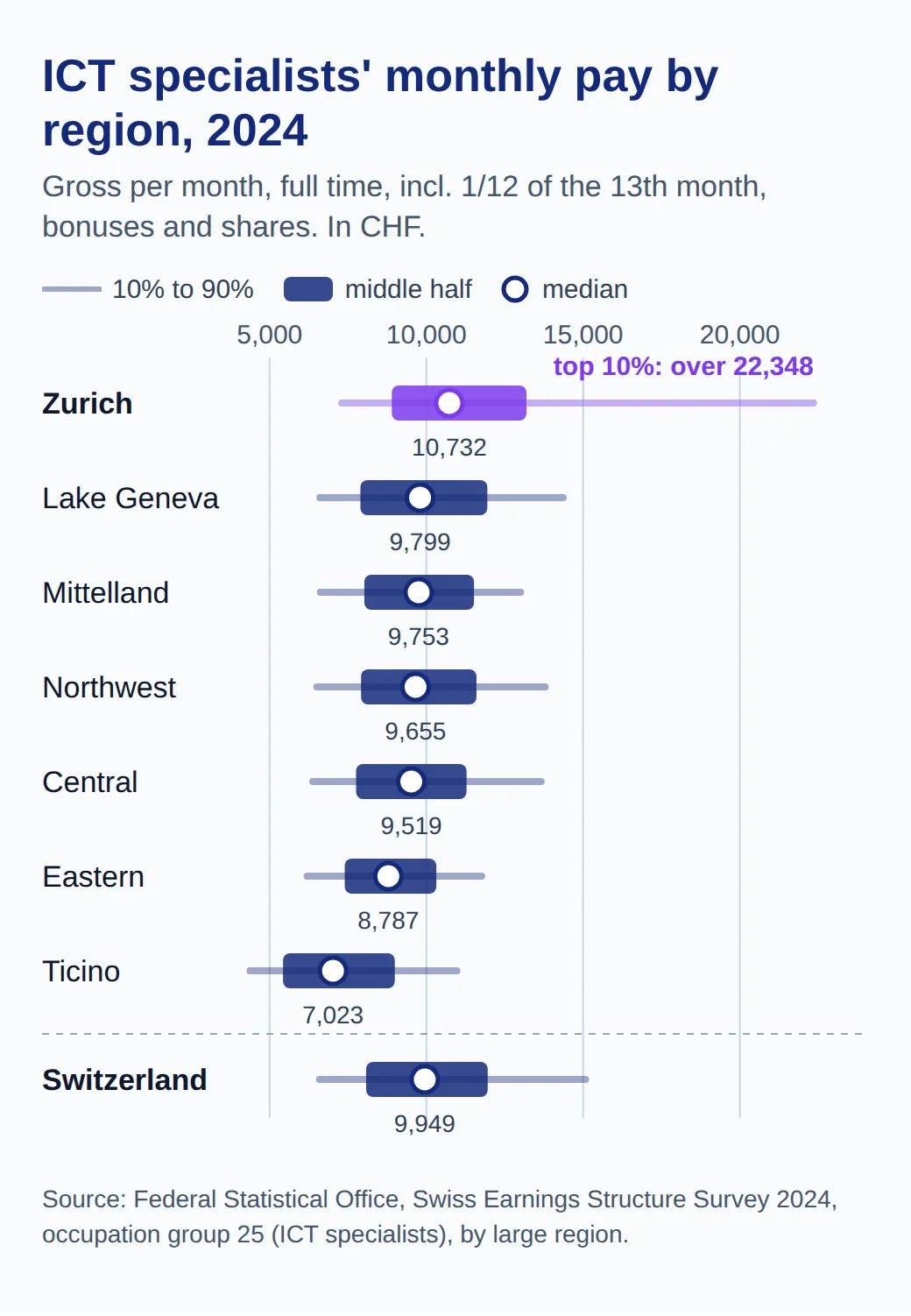
The four regions in the middle sit within CHF 300 of each other on the median. Eastern Switzerland is about CHF 1,160 below the national figure, and the real outliers are at the two ends: Zurich, about 8% above the national median, and Ticino, about 29% below it. Here are the medians with the cantons each region contains:
| Region | Cantons | Median per month | Per year (×12) |
|---|---|---|---|
| Zurich | Zurich | CHF 10,732 | CHF 128,784 |
| Lake Geneva | Geneva, Vaud, Valais | CHF 9,799 | CHF 117,588 |
| Espace Mittelland | Bern, Fribourg, Jura, Neuchâtel, Solothurn | CHF 9,753 | CHF 117,036 |
| Northwestern Switzerland | Aargau, Basel-Landschaft, Basel-Stadt | CHF 9,655 | CHF 115,860 |
| Central Switzerland | Lucerne, Nidwalden, Obwalden, Schwyz, Uri, Zug | CHF 9,519 | CHF 114,228 |
| Eastern Switzerland | Appenzell (both), Glarus, Graubünden, St. Gallen, Schaffhausen, Thurgau | CHF 8,787 | CHF 105,444 |
| Ticino | Ticino | CHF 7,023 | CHF 84,276 |
Geneva is the one other canton with its own published breakdown. Its statistics office, OCSTAT, cuts the same 2024 survey by industry for the canton alone, and its table for Geneva puts the median in IT services and information services at CHF 9,560 a month, with the middle half between CHF 7,333 and 11,661. That groups people by their employer's industry rather than by their job, and it leaves out the international organisations, but it lands close to the Lake Geneva figure for ICT specialists. Zug, often named as a high-pay canton, gets no figure of its own: it sits inside Central Switzerland, which comes in below the national median.
So for most developers the canton is worth a few hundred francs a month either way. The one place where the map really changes the picture is the top end of Zurich.
Why Zurich's top end pulls away
Zurich's median is only moderately higher, but its top tenth is in a different league. One ICT specialist in ten in the canton earned more than CHF 22,348 a month in 2024, about CHF 268,000 a year. In every other region that line sits between CHF 10,972 and 14,364. Among 30- to 49-year-olds in Zurich, the top tenth starts at CHF 27,418 a month. Even among those aged 29 or under it starts at CHF 17,964, against CHF 10,088 for the same age group nationally.
That top end grew fast. In the 2022 survey, Zurich's top-tenth line for ICT specialists was CHF 16,374. Two years later it was 36% higher, while the Zurich median rose 2.5%, from CHF 10,472 to 10,732. The FSO's table by industry shows the same shape for IT services firms in the canton: their top tenth moved from CHF 17,885 to 28,614 a month.
The survey cannot tell you which employers sit up there, but its definition gives a strong hint. Shares and bonuses count at one twelfth of their yearly value, so a firm that pays a large part of the package in equity lifts the top of the distribution without moving the middle. The canton's own statistics office looked at Zurich's pay level across all jobs in June 2026. It found wages about 9% above the rest of the country and explained roughly 45% of that gap with the economy's structure: many jobs in IT, telecoms and finance, and many large companies. Part of the rest, it says, is Zurich firms simply paying more, at least in the middle and lower wage ranges.
Keep one caveat in mind. These are survey estimates, and the highest tenth is the least precise part of any wage table. For most developers in Zurich the useful range is the middle half, CHF 8,897 to 13,192 a month, or about CHF 107,000 to 158,000 a year. Where you land inside it depends more on the job than on the postcode.
How much experience and responsibility add
Responsibility is one of the biggest levers the survey can measure. In IT services firms across Switzerland, the FSO's median ranges from CHF 8,685 a month for people with no management role to CHF 14,259 for middle and upper management, a rise of 64%. In between sit people who are responsible for how the work gets done but hold no management post (CHF 9,999), and lower management (CHF 12,141).
Age tells a similar story for ICT specialists: CHF 7,200 a month up to 29, CHF 9,995 from 30 to 49 and CHF 11,349 from 50. The bigger step comes early: from the under-30s to the 30-to-49 group the median rises by about CHF 2,800, and after that by about CHF 1,350.
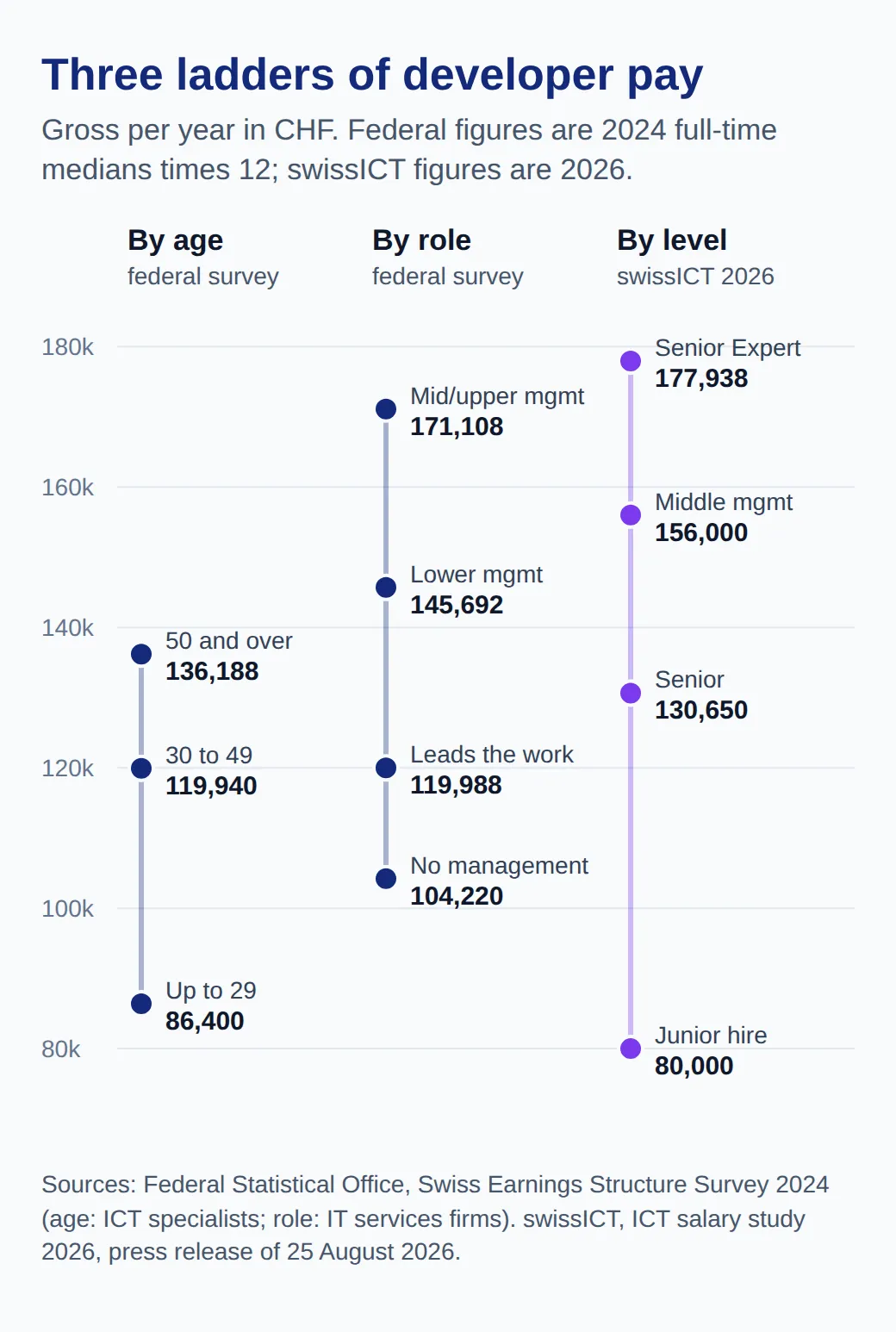
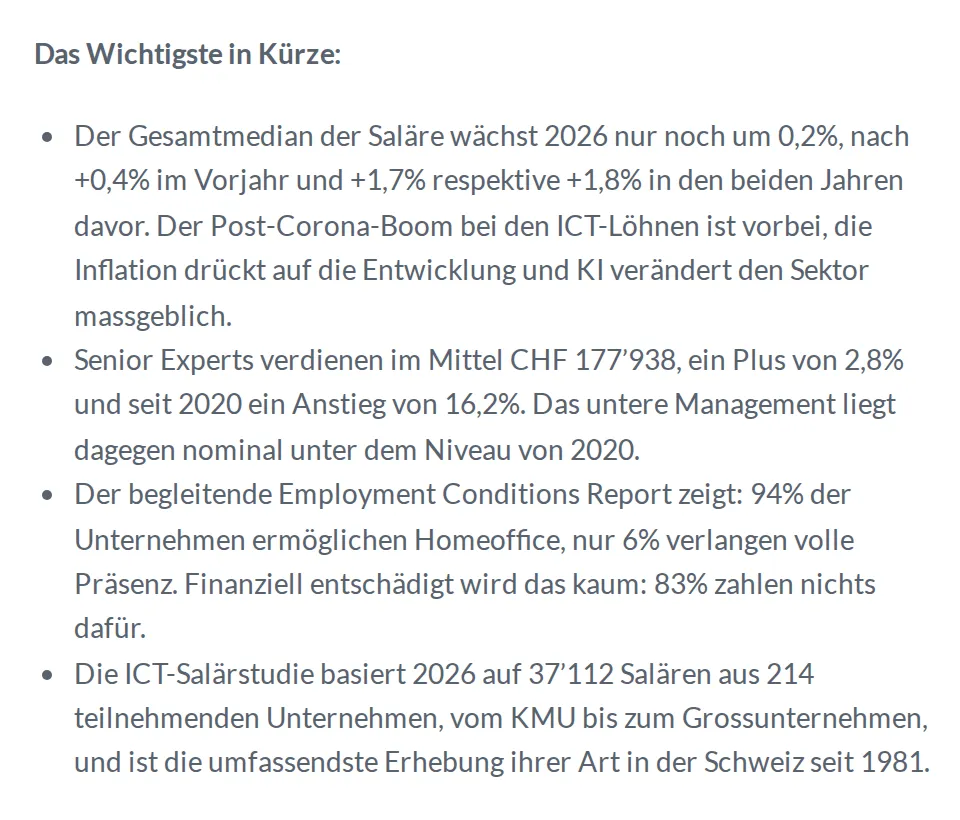
The swissICT salary study counts by career level instead of age. The industry association has run it every year since 1981, and the 2026 edition draws on 37,112 salaries from 214 companies, from small firms to large groups. Its full tables by role, region and company size are paid reports, but its press release of 25 August 2026 gives the headline levels: juniors joining in 2026 get CHF 80,000 a year, a senior earns CHF 130,650 and a senior expert CHF 177,938. That last figure is above middle management, at CHF 156,000. In swissICT's words, the specialist career has overtaken the management career on pay.
Bonuses widen the gap at the top. In 2024 a third of all employees in Switzerland got one, worth CHF 11,967 a year on average. Upper management in IT ("Informatik" in the FSO's list) averaged CHF 58,747, while people without a management role averaged CHF 4,601 across all industries.
Is developer pay still rising?
Slowly, if at all. The swissICT median grew 0.2% in 2026 after 0.4% in 2025, down from 1.7% and 1.8% in the two years before. swissICT calls the post-Covid boom over, and the growth it still finds is at the top: senior experts gained 2.8% in a year and 16.2% since 2020, while juniors gained 1.3% and professionals 1.9% over the same six years.
The federal figures say much the same for the middle of the market. The national median for ICT specialists went from CHF 9,461 a month in 2020 to 9,703 in 2022 and 9,949 in 2024, about 2.5% per two years. If you have read that developer pay jumps every year, that was true for the people at the top, and much less for everyone else.
What job ads actually offer
Real offers are harder to find than averages, because few employers print a figure. Of the 1,261 software engineering listings on our board on 17 October 2026, 62 named any pay at all and only 27 gave a yearly band in francs. Just over half of those, 14 of the 27, came from the canton of Bern, many of them from Swiss Post and PostFinance. PostFinance announced in 2023 that from 2024 its ads would as a rule state a salary range, senior management excepted. Swiss Post's software ads on our board give one too.
Here are six of those bands next to their monthly equivalent, divided by 12 to match the federal figure:
| Employer, role | Place | Per year | Per month (÷12) |
|---|---|---|---|
| Swiss Post, Software Developer | Bern | CHF 118,900 to 133,900 | CHF 9,908 to 11,158 |
| Swiss Post, Senior Software Developer | Bern | CHF 133,300 to 148,300 | CHF 11,108 to 12,358 |
| PostFinance, Senior Software Engineer | Bern | CHF 130,000 to 145,000 | CHF 10,833 to 12,083 |
| PostFinance, Senior DevOps Engineer | Bern | CHF 110,000 to 130,000 | CHF 9,167 to 10,833 |
| devedis, senior full-stack engineer | Bern | CHF 100,000 to 120,000 | CHF 8,333 to 10,000 |
| Helsana, requirements and test team lead | Dübendorf (ZH) | CHF 141,500 to 157,200 | CHF 11,792 to 13,100 |
All six were posted between 5 September and 2 October 2026. Five state the band for a 100% workload; devedis, an owner-run software agency, gives it next to a workload of 80 to 100%. Swiss Post and PostFinance add that pay can fall slightly below or above the band. Set against the Espace Mittelland figures, where the median is CHF 9,753 and the top quarter starts at CHF 11,520, Swiss Post's senior band begins just under that top-quarter line. The devedis band for a senior engineer sits around the regional median. The Helsana team lead in the canton of Zurich lands just under Zurich's top-quarter line of CHF 13,192.
There's a gap the table makes plain. None of the 27 published bands went above CHF 157,200 a year, while one ICT specialist in ten in Zurich earns more than CHF 268,000. No employer printing a band in francs on our board comes near that line, so the ads you can read show the solid middle of the market, not its peak.
What moves your number most
Put the sources side by side and the drivers sort themselves roughly by size. Responsibility is the largest the survey measures: from no management role to middle and upper management adds about 64% to the median. The employer probably matters as much, but no table shows it directly; the clearest sign is Zurich's top tenth, where bonuses and shares count in the figure and the line has moved far from everyone else's. Age and experience add about 58% between the under-30s and the over-50s, most of it between the under-30s and the 30-to-49 group.
Region matters less than its reputation. Four of the seven regions sit within CHF 300 of each other on the median. Ticino is about CHF 2,900 a month below the national figure, and Zurich is the only region whose upper range clearly stretches further. Gender and nationality show gaps too; we've put those numbers in the questions below.
Before you name a number
Start with your own profile, not an average. The FSO's Salarium calculator uses the 2024 survey and lets you set the industry, the region and the occupation group, then refine the profile with details such as your age and education. It estimates a monthly wage for that profile. The FSO is clear that the results come from a model and are not a salary recommendation, but they give you a figure built for your own case.
Then put every offer on the same footing. Turn a monthly salary into a yearly one with the number of payments in the contract (12 or 13), add any fixed bonus, and divide by 12 when you compare it with the survey. If an ad shows no band, ask for one before the second interview; at PostFinance, for one, a band is part of the ad as a rule. And if you are coming from outside the EU, the canton checks that your pay is usual for the place and the job before it grants a permit, which our guide to work permits for non-EU developers explains step by step.
When you know your number, compare it with what's open now on our software engineering jobs in Zurich board.
Common questions
- Is a Swiss developer salary paid in 12 or 13 instalments?
- Both are common. In 2024, 75.9% of all employees in Switzerland received a 13th month's pay, according to the federal wage survey. The salary bands in job ads are usually annual figures, so compare offers by their yearly total, not by the monthly payslip.
- Do women in software jobs earn less than men in Switzerland?
- A little, on the median. In 2024, women among ICT specialists earned CHF 9,469 a month and men CHF 10,019, a gap of about 5.5%. Across the whole Swiss economy the median gap was 8.4%. The survey figures do not adjust for age, role or employer, so they show the gap, not its cause.
- Do developers on a B permit earn less than Swiss developers?
- The federal survey only answers this for the whole economy, not for software jobs alone. In jobs with a high level of responsibility, B permit holders earned more than Swiss employees in 2024 (CHF 13,090 against 10,989 a month). In jobs without a management role it was the other way round (CHF 5,421 against 6,765).
- Does an 80% job pay 80% of the advertised band?
- Five of the six bands we quote are stated for a full-time workload, and the federal figures are converted to full time too. Expect the pay to be scaled to your percentage, and ask the employer to confirm the figure for the workload you agree on before you sign.
More posts
All posts
Swiss Work Permit for Non-EU Software Developers in 2026
How a non-EU developer gets a Swiss B or L permit in 2026: who applies, quotas per canton, why developers count as a shortage job, pay checks and timelines.

Freelance Developer in Switzerland: AHV, VAT, Pensions 2026
Freelancing as a developer in Switzerland: why one client can make you an employee, staffing firms, the CHF 100,000 VAT line and pillars 2 and 3a.