Freelance Developer in Switzerland: AHV, VAT, Pensions 2026

Before your first invoice
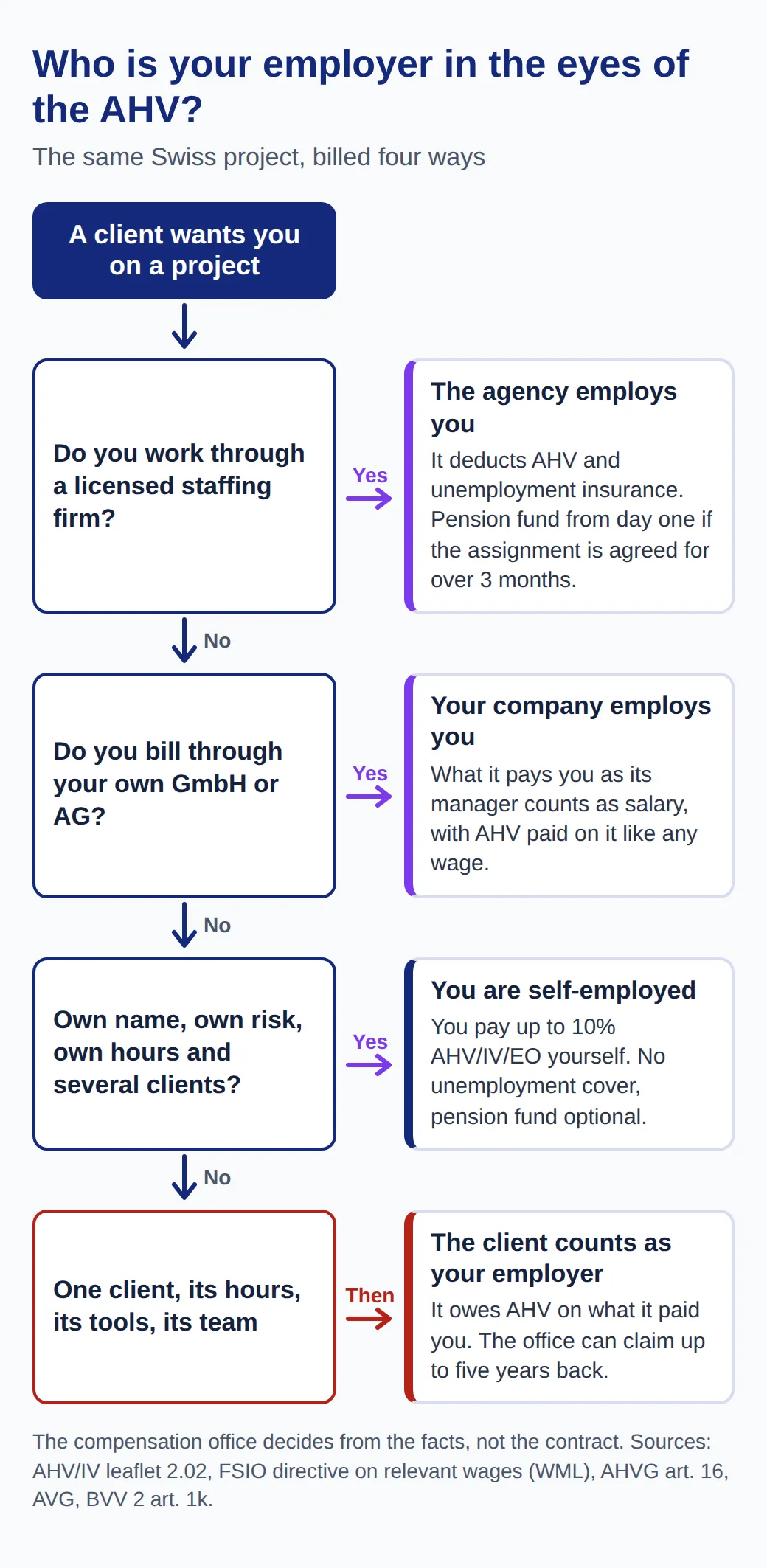
You can freelance as a developer in Switzerland, but you do not decide that you are self-employed. Your AHV compensation office does, for each activity, from the facts rather than your contract. If you work for one client, on its hours and its laptop, the office will normally treat you as that client's employee. That is why many contractors bill through a staffing firm instead.
Once you are recognised as self-employed, four things change: you pay the whole AHV contribution yourself, VAT applies once your turnover reaches CHF 100,000 a year at home and abroad, you have no unemployment insurance, and no pension fund unless you join one. Below is how each of these works, with the AHV leaflet or the law behind it linked so you can check. The figures are the ones for 2026; where the Federal Council has already set the 2027 values, we give those too.
Who decides whether you are self-employed?
The compensation office (Ausgleichskasse) that collects your AHV contributions decides, and it looks at what you actually do. AHV here stands for the whole first-pillar package: old-age and survivors' insurance, disability insurance (IV) and income compensation (EO). The office's leaflet 2.02 on self-employed contributions puts it plainly: the assessment is "based on the economic facts rather than the individual's contractual status". The same leaflet adds a line that surprises many developers: someone who works for an employer and is paid a salary is employed, and "generally speaking, this also includes agents and freelance staff."
The leaflet names four signs of self-employment. You present yourself under your own business name, with invoices in your name. You carry the financial risk: you pay for your own equipment, bear the risk that a client does not pay, and rent your own premises. You decide your own hours, how you organise the work and whether you pass some of it to subcontractors. And you work for several clients. On that last point the leaflet is blunt: "if you work for a sole client, you are normally regarded as an employee."
The federal social insurance office's directive on relevant wages (in German, known as the WML, in the version of 1 May 2026) adds three points that matter for software work. Consulting and freelance work need few large investments by nature, so the office looks mainly at how dependent you are. If you keep working to a large extent for your former employer, the signs of self-employment must clearly outweigh the others. And having several clients does not, on its own, make you self-employed. What the contract calls you is not decisive either, and neither is an agreement between you and the client that you are self-employed.
To be recognised, you apply to a compensation office. The federal site selbststaendig-erwerbend.ch links the form and lists the evidence you may need to attach: quotes and invoices to clients, signed client contracts, proof of the capital you put in, and your website or other marketing. The decision covers that activity only, which matters as soon as most of your work comes from one client.
Can you freelance for just one client?
You can, but on paper it rarely holds as self-employment. The WML lists what shows dependence: the client can give you instructions, you are part of its hierarchy, you must do the work in person, you may not work for competitors, and you have to be present at set times. A typical six-month developer contract ticks most of these boxes. You join the client's standups, take tickets from its backlog, use its laptop and accounts, keep its core hours and may not subcontract the work. Seen through the WML, that is an employee with an invoice.
The directive is just as clear about risk. If your only economic risk is that the client could stop giving you work, so that losing it would feel like losing a job, that is a typical sign of employment.
The consequence falls on the client first. If the office decides your fees were really wages, the client is treated as your employer and owes AHV contributions on what it paid you. Under the AHV Act (art. 16), contributions can be claimed by a decision issued within five years after the end of the year they were owed for. That is the risk a Swiss company weighs when it asks you to come through a staffing firm or your own company rather than as a sole proprietor.
The assessment runs per activity, so you can be self-employed for two small agencies and an employee of a third client at the same time. If you want the status to hold, build the facts the leaflet asks for: invoices under your own business name, more than one client over the year, your own equipment, the freedom to choose your hours and to bring in help. A contract with no duty to be on site at set hours also helps, since a presence obligation is one of the WML's signs of dependence.
Contracting through a staffing firm
Through a staffing firm, the question of status goes away: the agency employs you and hires you out to the client. Swiss law calls this staff leasing (Personalverleih), and the Recruitment Act (AVG) requires the agency to hold a licence from the cantonal labour office (art. 12). You can check any agency in SECO's directory of licensed recruitment and staff leasing firms. Without a licence, the agency's contract with you is invalid.
Your contract with the agency must normally be in writing and must state the type of work, where and when the assignment starts, its length or the notice period, your hours, your pay and the social insurance deductions, and what happens in case of overtime, illness, accident and holidays (AVG art. 19). In the first six months of an open-ended assignment, notice can be as short as two days in the first three months and seven days after that.
Two clauses in the law protect you if the client wants to hire you. Any agreement that stops or hinders you from joining the client after the assignment is void (art. 19 para. 5 and art. 22 para. 2). The agency may only charge the client a fee if the assignment lasted less than three months and you join within three months of its end, and that fee is capped at the agency's admin and profit margin for three months (art. 22 paras. 3 and 4).
As an employee you get the employee package. The agency deducts AHV, IV and EO plus unemployment insurance: 12.8% of your pay up to CHF 148,200 a year, half from you and half from the agency, per the AHV's leaflet 2.08 on unemployment insurance (in German). For the pension fund, the ordinance on occupational pensions (BVV 2, art. 1k) sets the rule for temporary work, as long as you earn more than CHF 22,680 a year. If it is agreed before you start that your assignments will last more than three months in total, you are insured from day one. If an assignment is only later extended past three months, cover starts when the extension is agreed, and back-to-back assignments that add up to more than three months bring you in from the fourth month. Staff leasing also has its own collective agreement, which SECO's list of binding agreements shows as binding for all of Switzerland until 31 December 2027.
The price is the agency's margin, which comes out of the rate the client pays. What you buy with it is a settled status, unemployment cover and a pension fund. If you only ever have one client at a time, it is often the honest route.
What the AHV costs you as self-employed
As a self-employed developer you pay 10.0% on your income: 8.1% for old-age and survivors' insurance, 1.4% for disability insurance and 0.5% for income compensation. For an employee the rate is 10.6%, and the employer pays half of it, as the AHV's leaflet on salary contributions shows. Below CHF 60,500 a year your rate drops on a sliding scale, down to 5.371% from CHF 10,100. Under CHF 10,100 you pay a minimum of CHF 530 a year.
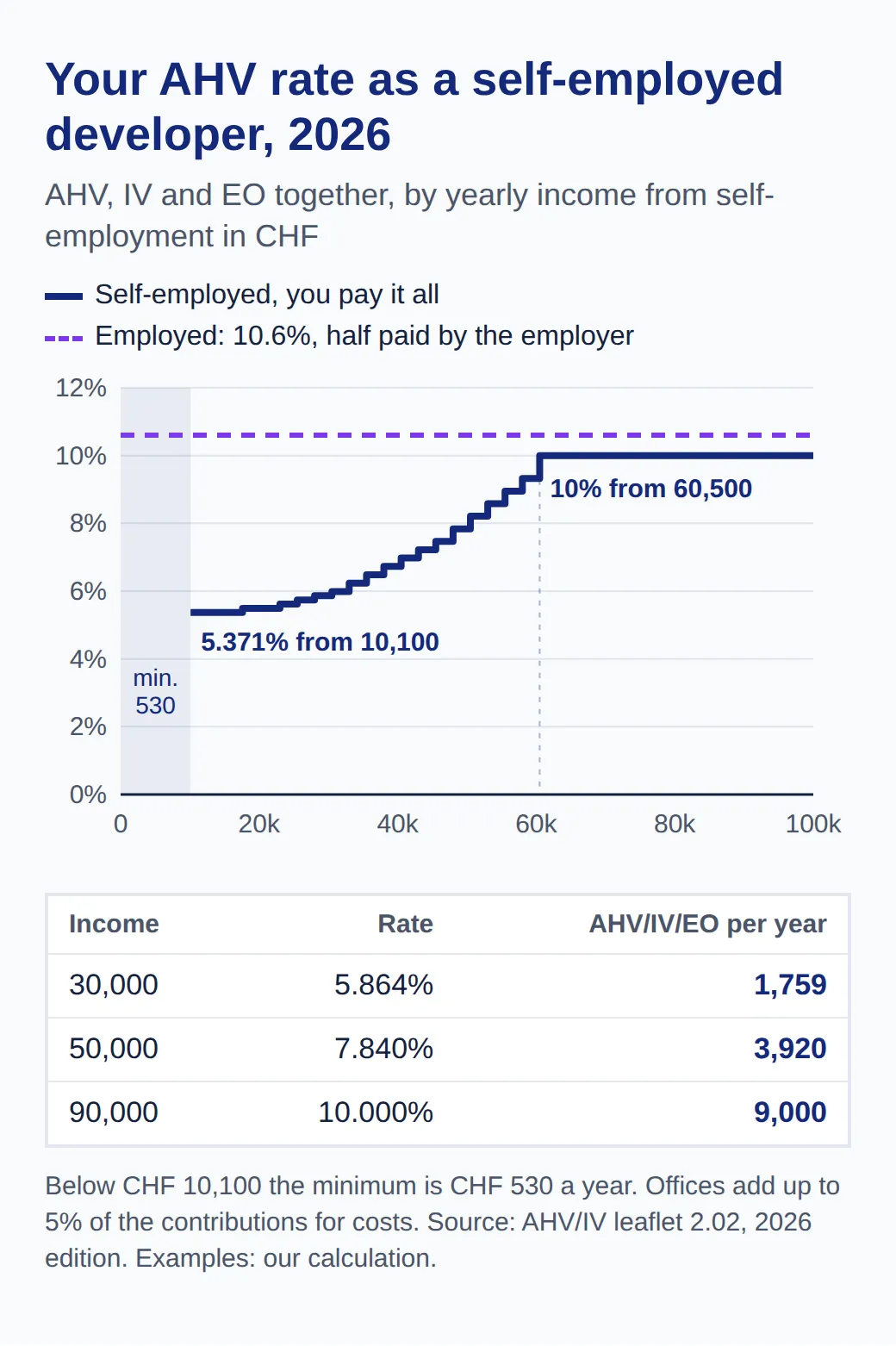
A few details change the real bill. Your compensation office adds up to 5% of your contributions for its admin costs. The income it uses comes from your tax assessment, with your own AHV contributions added back, and it first deducts interest on the capital you have invested in the business. The office sets provisional payments from the income you expect, payable each quarter by the 10th day after the quarter ends, and settles the difference once your tax assessment arrives. If your provisional payments come to less than 75% of the final amount, you pay 5% default interest from the start of the second year after the contribution year, so tell the office early when a good year is coming.
The Federal Council has already moved the figures for 2027: from 1 January the sliding scale will run from CHF 10,300 to 61,500, and the minimum rises to CHF 541. The limit for a side business stays at CHF 2,500 a year: at or below it, contributions are only collected if you ask.
Two more costs come with the status, according to the AHV's leaflet 2.09 on the self-employed (in German). You must join a family compensation fund and pay contributions on income up to CHF 148,200, at a rate that varies by canton. And you have no compulsory accident insurance: your health insurance covers treatment after an accident, and you can take out voluntary accident insurance for the rest, which pays daily allowances and pensions. The insured earnings you choose there must be at least 45% of CHF 148,200.
When do you have to charge VAT?
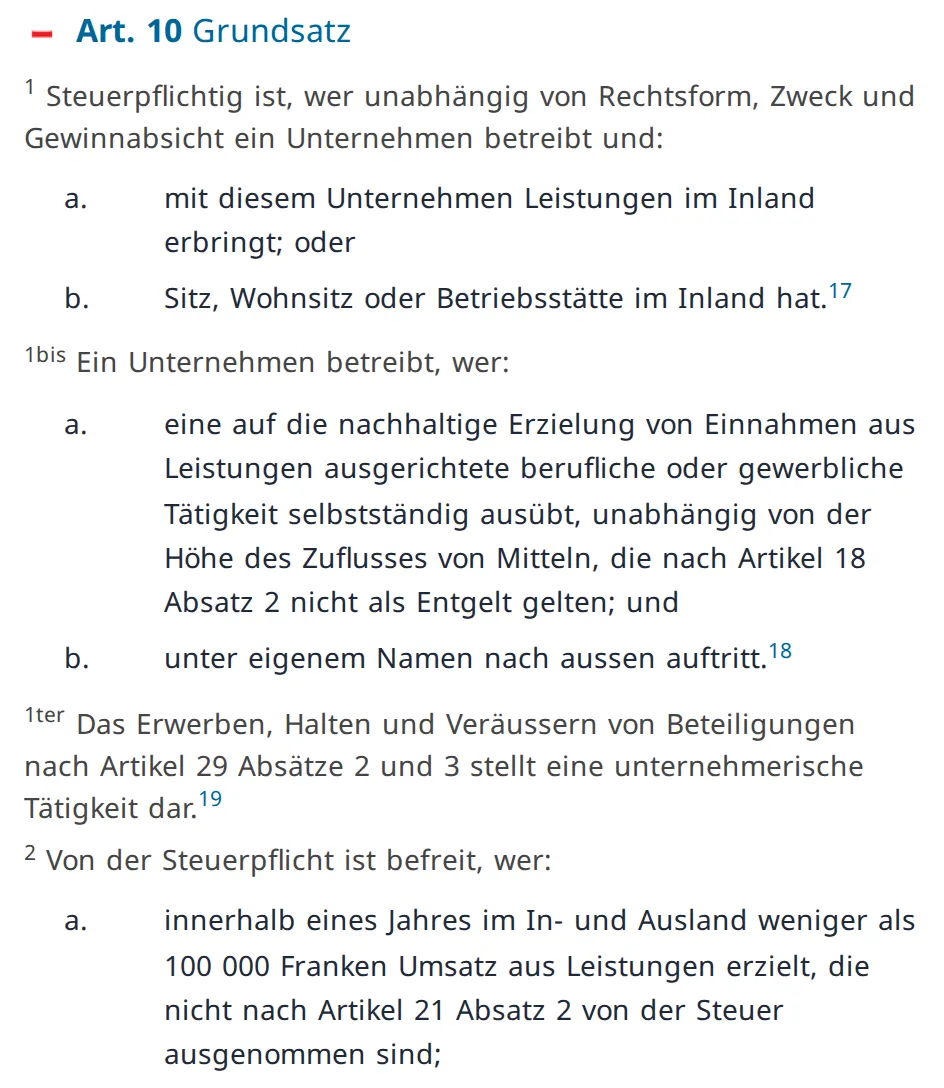
You must register for VAT once your turnover reaches CHF 100,000 a year, and the law counts turnover in Switzerland and abroad together. The VAT Act (art. 10 para. 2) exempts a business only while its turnover within a year, in Switzerland and abroad combined, stays under CHF 100,000, leaving aside the few services that are exempt from VAT altogether.
That detail catches developers with foreign clients. An invoice to a company in Germany usually carries no Swiss VAT, because for most services the place of supply is where the client has its business (art. 8 para. 1). The turnover still counts towards your CHF 100,000. A developer billing CHF 70,000 to a Berlin client and CHF 40,000 to a Zurich one is over the line.
Liability starts once last year's turnover reached the limit, or from the start if it is foreseeable that you will cross it within 12 months of starting or growing the business (art. 14 para. 3). You then have 30 days to register with the Federal Tax Administration (art. 66). From then on you add 8.1% VAT to Swiss invoices and file returns every quarter, or once a year if you apply for it (art. 35). Below the threshold you may still register voluntarily (art. 11), which lets you deduct the VAT you pay on your own business purchases (art. 28) but means charging VAT to Swiss clients. Small businesses can apply to use a net tax rate set for their sector instead of tracking input tax, as long as turnover stays under CHF 5,024,000 and the tax under CHF 108,000; returns are then filed every six months (arts. 35 and 37).
The same CHF 100,000 shows up in the Code of Obligations (art. 931): a sole proprietor whose business had revenue of at least that much in the last financial year must enter it in the commercial register. The code exempts the liberal professions unless they are run as a commercial business. If you are unsure which side of that line your practice falls on, the cantonal commercial register office can tell you.
Pillars 2 and 3a when you work for yourself
As a self-employed developer you are not in any pension fund unless you join one. The second pillar, the occupational pension, is not compulsory for the self-employed, as leaflet 2.09 explains. You may insure yourself voluntarily: with the pension fund of a professional or trade association, or with the Substitute Occupational Benefit Institution (Stiftung Auffangeinrichtung BVG), which must accept self-employed people who have no other option. There, the insured income in 2026 is the part between CHF 26,460 and 90,720, the limits in BVV 2, art. 5, with an option to insure more up to CHF 148,200. From 2027 the band moves to CHF 26,880 to 92,160. If you have no staff, you can book at most half of your contributions as a business expense; the rest goes into your private tax deductions.
Without a pension fund, pillar 3a, the tax-favoured private pension, becomes your main tool. The ordinance on pillar 3a (BVV 3, art. 7) lets you deduct up to 20% of your earned income, capped at CHF 36,288 in 2026. If you are in a pension fund, through a staffing firm or a voluntary plan, the cap is CHF 7,258. Both rise in 2027, to CHF 36,864 and 7,373.
| Pillar 3a cap | 2026 | 2027 |
|---|---|---|
| No pension fund (20% of earned income, at most) | CHF 36,288 | CHF 36,864 |
| With a pension fund | CHF 7,258 | CHF 7,373 |
Since 2025 you can also fill gaps later (art. 7a). In a given year you may pay in for years in which you did not use your full cap, going back up to ten years, but only for gaps from 2025 on, only if you first pay that year's full regular amount, and never more than CHF 7,258 as a catch-up in one year, even if you have no pension fund. A slow first year of freelancing is therefore not lost for good, but it takes time to make up.
The choice between the two pillars is not either-or. A voluntary pension fund adds cover for disability and death, while pillar 3a with a bank is mainly a savings plan; leaflet 2.09 notes that 3a policies with insurers can add risk cover too. What you lose by joining a pension fund is the larger 3a deduction.
If you hold a permit
Your permit has to allow self-employment. EU/EFTA nationals who prove they are genuinely self-employed get a B permit valid for five years, according to the State Secretariat for Migration's FAQ; they can only start once the cantonal authority has the documents it asks for.
For non-EU/EFTA nationals the rules are tighter. Under the Foreign Nationals and Integration Act (art. 38), a C permit holder may work as self-employed anywhere in Switzerland. A B permit holder may be allowed to switch to self-employment if it is in the economic interest and the financial and business conditions are met (art. 19 a and b). Working through a staffing firm keeps you an employee, but the agency may only hire foreign nationals who are allowed to work and to change jobs (AVG art. 21). We cover the employee route for non-EU developers in our guide to the Swiss work permit for software developers.
What to do before your first invoice
Decide first which of the three routes fits the work you actually have. One client, full time, for months: a staffing firm, or a permanent job if that is what the client really wants. Several clients, your own tools and hours: apply to a compensation office for recognition as self-employed before you send the first invoice, and keep the evidence the leaflet asks for. Then set your rate with the costs above in mind: up to 10% AHV plus admin costs, a family fund contribution, accident cover, your own pension saving and no paid holidays or sick pay. Our post on developer salaries in Switzerland gives you the employed benchmark to compare a day rate against.
Keep a running total of all your turnover, Swiss and foreign, so that the VAT registration does not surprise you, and put this year's pillar 3a payment in before 31 December. If the freelance life turns out not to suit you, the permanent roles on our Zurich software engineering board are a search away.
Common questions
- Can I freelance on the side while I have a full-time job?
- Yes, as far as the AHV is concerned. Each activity is judged on its own, so you can be employed in your main job and self-employed for a side project. If your side income from self-employment stays at CHF 2,500 a year or less, contributions on it are only collected if you ask. Read your employment contract before you start, because it can limit side work for clients in the same field.
- Do I need a GmbH to work as a freelance developer?
- No. You can work as a sole proprietor in your own name. A GmbH needs at least CHF 20,000 of capital, and what it pays you as its manager counts as salary, so you become its employee for the AHV. In return, a client contracts with your company rather than with you as a person.
- Do I charge Swiss VAT to a client in Germany?
- No. For most services between businesses, the place of supply is where the client has its business, so a German client's invoice carries no Swiss VAT. That turnover still counts towards the CHF 100,000 threshold, though, and the client's own country has its own rules for the invoice.
- Can I claim unemployment benefits if my freelance work dries up?
- Not from your self-employment. Self-employed people cannot join the Swiss unemployment insurance, so the months you bill as a sole proprietor build no cover. If you work through a staffing firm, you are its employee and pay unemployment insurance contributions like any other employee.
More posts
All posts
Software Engineer Salary in Switzerland 2026, by Region
Software engineer salary in Switzerland: federal pay data by region and age, swissICT's 2026 levels, real salary bands from job ads, and what drives the gap.

Swiss Work Permit for Non-EU Software Developers in 2026
How a non-EU developer gets a Swiss B or L permit in 2026: who applies, quotas per canton, why developers count as a shortage job, pay checks and timelines.