Tech Jobs in Switzerland Beyond Zurich: Five Hubs in 2026

Where the jobs are
Outside Zurich, Switzerland's developer jobs sit in five places, and each hires for something different. Bern is the second-largest market on our board, with federal offices and federal companies among its main employers. Geneva hires for privacy software, commodity trading and CERN, Lausanne for deep tech and industry, Zug for SAP and .NET more than crypto, and Basel far fewer developers than its pharma fame suggests.
Most pages about tech jobs in Switzerland name the same cities and the same reputations, then stop. We counted instead. In mid-October 2026 we read every software engineering ad on our board for the main hubs, removed repeats of the same ad, and noted who posted it, where and with which skills. Then we put each hub next to two costs the federal government publishes for every canton: average rent and the health insurance premium. Below is what each hub hires for, how big it really is, and what it costs to live there.
Bern, not Geneva, is number two
Once repeats are taken out, the canton of Zurich had 293 distinct developer ads. Bern came next with 110, then Geneva with 95, Vaud with 67, Zug with 27 and the city of Basel with 19. If you expected Geneva in second place, the reason is who employs developers in each city.
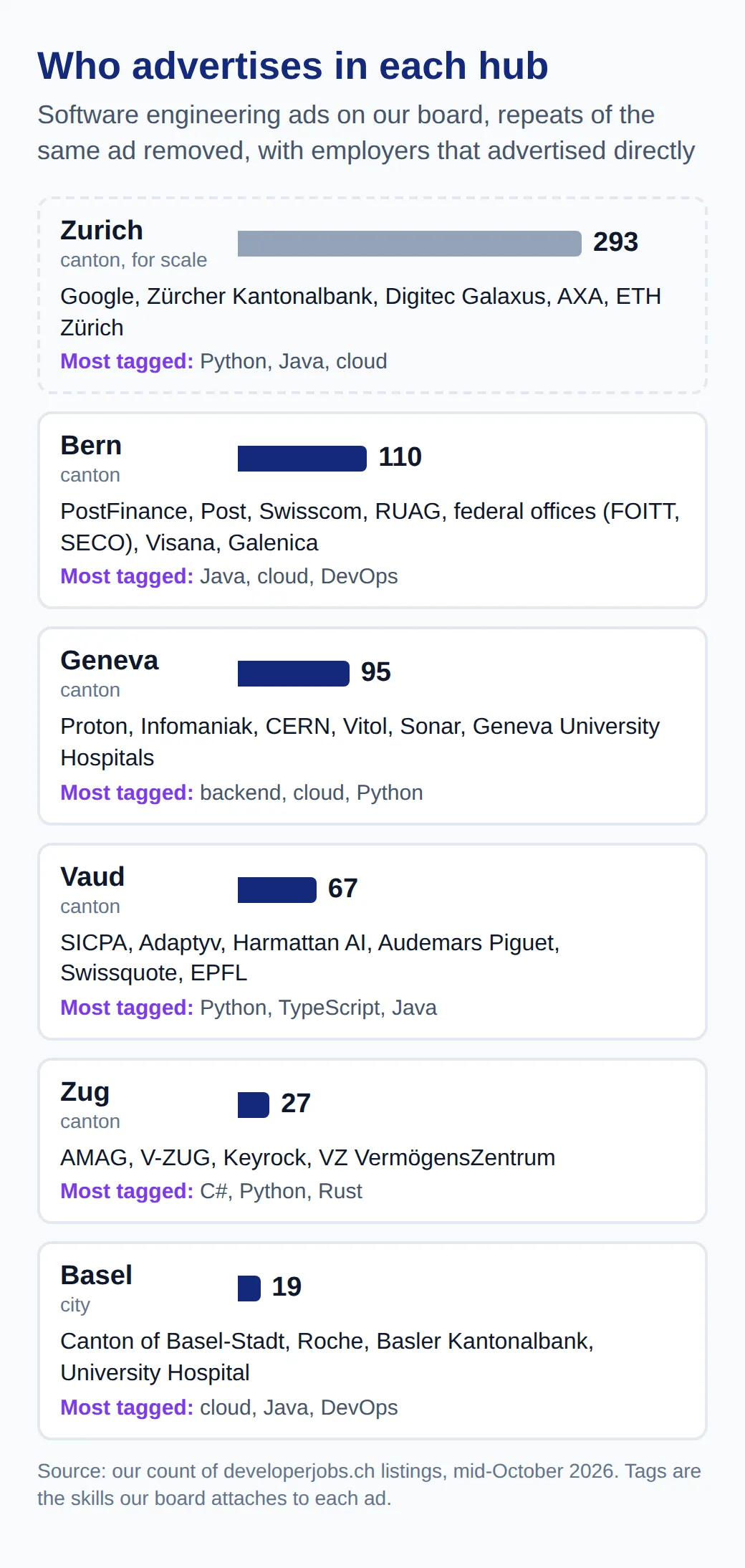
Repeats matter more than you'd expect. The live count on our Basel page stood at 58 when we looked, but 27 of those were the same senior Java role, posted again and again by one recruitment agency. Raw counts on any job site flatter some cities, so read a hub's size from distinct roles, not from the number at the top of the page. The same reading also tells you what kind of employer you'd be working for, and that is where the hubs differ most.
Bern: the state and its companies
Bern hires developers to build public services. Of its 110 distinct ads, 8 came straight from federal offices: the Federal Office of Information Technology, Systems and Telecommunication (FOITT), the State Secretariat for Economic Affairs (SECO), the Federal Intelligence Service, fedpol, the justice department's IT centre and the Armed Forces' Cyber Command. Another 17 came from PostFinance, Swiss Post, Swisscom, RUAG and SBB. Swiss Post, Swisscom, RUAG and SBB are on the Federal Finance Administration's list of 22 enterprises and institutions the Confederation controls, and PostFinance belongs to Swiss Post. Together that is 25 ads, more than one in five.
FOITT alone says it has 1,700 employees and calls itself the largest IT service provider in the federal administration. Its ads on our board were for Zollikofen, just outside the city. PostFinance was the busiest single employer, with platform, Kubernetes and payment roles. Around them sits a ring of insurers and health firms (Visana, Die Mobiliar, Galenica) and IT consultancies that place developers on client projects.
The stack follows the customer. Java was the most frequent tag, then cloud, DevOps and Kubernetes, with Angular on the front end. Some ads print salary bands, which gives you a rare look at real numbers: Swiss Post put CHF 118,900 to 133,900 on a software developer role and CHF 133,300 to 148,300 on the senior version. For how that compares with the rest of the country, see our developer salary guide.
Bern also had the highest share of ads open to remote work: 44 of 110, or 40%, against under 30% in Zurich. If you want a public-sector employer without moving to the capital, that is worth knowing. Geneva, the next hub, works almost the other way round.
Geneva: privacy software, trading and CERN
Geneva's developer market is built around a few distinctive employers, and most of them want you in the office. Only 13 of its 95 distinct ads were marked as allowing remote work, the lowest share of any hub we counted.
Proton, which builds encrypted mail, VPN and cloud storage, posted 17 distinct roles, more than any other direct employer in the canton. Infomaniak, which sells itself as an ethical cloud, advertised from Carouge. Trading houses form a second group: Vitol hired for profit-and-loss and risk systems, and Qube Research & Technologies for a quantitative developer in commodities. Private banking brings integration and Front Arena work, much of it through agencies.
Then there is international Geneva. The Federal Department of Foreign Affairs counts over 40 international organisations in the city and representations of around 180 states. CERN alone had five software ads on our board. Jobs at these organisations follow their own rules: staff of many of them receive a legitimation card from the federal foreign ministry, which serves as their residence permit, instead of a normal cantonal permit. Check the organisation's own conditions before you compare its offer with a private one.
Language is the other thing to check. Across Geneva and Vaud together, roughly a third of the ads we read asked for working French, usually fluent or at C1 level, and about one in ten called it a plus or asked you to commit to learning it. CERN's ads, for example, ask for spoken and written English "with a commitment to learn French". Lausanne shares the language but not the employer mix.
Lausanne and Vaud: EPFL and industry
Vaud is where research turns into companies. EPFL, the federal institute of technology in Lausanne, reports a record 39 new startups in 2025, which raised CHF 701 million between them that year. Its Innovation Park says 2,950 people work there, and it hosts 35 innovation cells and R&D centres of large companies.
On our board that showed as small teams hiring a handful of engineers each: Adaptyv for backend and lab automation work, Harmattan AI for embedded and mission software, The Flex for product engineers. EPFL itself advertised a full-stack role on a construction AI project. Next to them sit established firms with very specific needs. SICPA in Prilly wanted computer vision, embedded and cloud platform engineers, Swissquote in Gland Android and Python developers, and the watchmaker Audemars Piguet posted tech lead and intern roles in the Vallée de Joux. Nexthink, also in Prilly, wanted C++ for operating system internals.
Python was the most common tag in Vaud, ahead of TypeScript and Java. Note that only about half of Vaud's 67 distinct ads were for the city of Lausanne; the rest spread along the lake from Nyon to Montreux and up into the valleys. For the city alone, see our Lausanne board. Basel has the opposite problem: plenty of fame, few developer ads.
Basel: a pharma city with a small developer market
Basel's economy rests on life sciences, but that does not translate into many software jobs. The canton's own economic statistics put it in one line: life sciences produce about 40% of Basel-Stadt's value added but employ only about 10% of its workers, against about 2% for Switzerland as a whole.
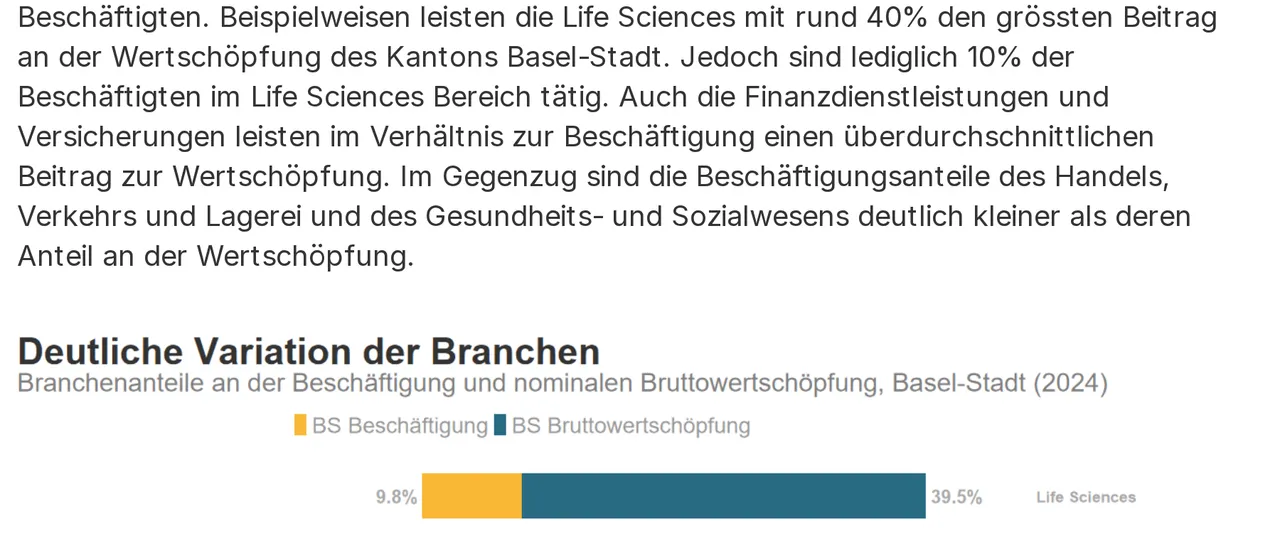
A sector that earns a lot with relatively few people does not need a large army of developers in the city. Our 19 distinct Basel ads confirm it. Roche had one, for a senior engineer in lab automation, and an agency advertised a data and AI platform role for drug discovery. The rest came from employers you'd find in any Swiss city: the cantonal administration, which wanted a senior engineer for AI and process automation, Basler Kantonalbank, the University Hospital, the hosting company cyon and Swiss AviationSoftware.
If you want pharma IT, look for data, lab automation and drug discovery platforms, and read past job titles that don't say software engineer. The neighbouring canton of Basel-Landschaft added only 6 listings when we looked. Zug, our last hub, has the strongest brand of all, and the gap between brand and ads is just as wide.
Is Zug still the Crypto Valley?
On the evidence of its job ads, Zug is a corporate and industrial hub with a crypto side. Of 27 distinct developer ads in the canton, only two were clearly crypto jobs: Keyrock's Rust roles for trading systems, whose ads ask for a "crypto enthusiast". Blockstream, which describes itself in its ads as a market leader in Bitcoin security, posted four roles in Zurich and one in Geneva, none in Zug.
The biggest direct employer was the AMAG group, whose IT unit in Cham, about 200 people by its own count, wanted SAP developers and an SAP architect. The appliance maker V-ZUG wanted software and SAP engineers, VZ VermögensZentrum .NET developers, and several agencies advertised embedded Rust and test automation roles in Risch. C#, Python and Rust were the most frequent tags.
None of this would surprise the cantonal government. In its 2018 answer to a parliamentary question, it said the canton "cannot be reduced to the Crypto Valley brand" (our translation) and listed pharma and biotech, medtech, high tech, life sciences, financial services, international trade and headquarters as its other strong clusters. The crypto link is still official, though: since February 2021 you can pay your Zug taxes in Bitcoin or Ether, up to CHF 1.5 million per bill. What Zug is also known for is cost, and that is where the hubs separate again.
What does it cost to live in each hub?
Two large fixed costs differ sharply between cantons: rent and health insurance. The Federal Statistical Office publishes the average net rent per canton, and the Federal Office of Public Health the average premium per canton. Put side by side, they cancel out more than you'd expect.
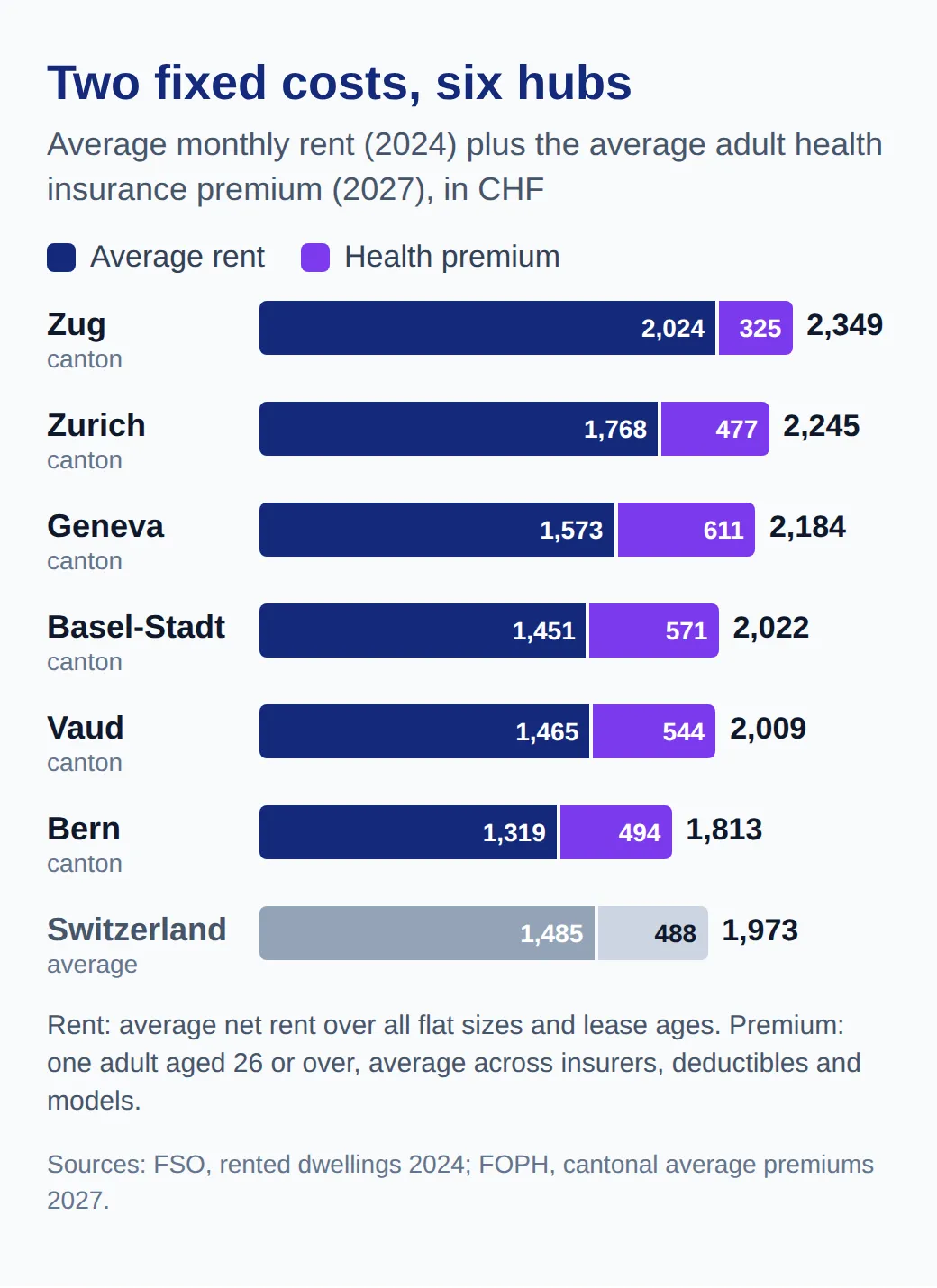
Zug has the highest rents in Switzerland, CHF 2,024 a month on average in 2024, but also the lowest premium in the country, CHF 324.90 for an adult in 2027. Geneva is the reverse: its rent is below Zurich's, but its adult premium of CHF 610.60 is the highest in the country. Bern comes out cheapest overall, at CHF 1,813 for the two together, because its average rent of CHF 1,319 is the lowest of the six.
Read these as a starting point, not a quote. The rent figure averages all flat sizes and all leases, and the FSO notes that the longer a household has rented, the lower its rent tends to be. Newly built flats cost the most: the FSO's own example is a four-room flat built in the last two years at CHF 2,304 on average nationally, against CHF 1,838 for an older one. The premium is an average across insurers, deductibles and models, so your own can be well above or below it. Income tax also differs a lot between cantons and even communes; the federal tax calculator lets you compare the same salary in several places. Pay, cost and employers point in different directions in each hub, so the right choice depends on which of them matters most to you.
Which hub fits you
Start from the kind of employer you want, not the city. If you want stable work on large systems and a real chance of remote days, Bern and its federal ecosystem are the obvious place, and Java with Angular is the safe stack. If you speak French or are ready to learn it, Geneva and Vaud open up privacy software, trading, CERN and the startups around EPFL. Zug suits .NET and SAP developers and a few Rust specialists, and Basel works best if you have life sciences or data experience to offer.
Then check three things before you apply. Count distinct roles, not listings, when you judge a market. Look at the language line in the ad, especially in the French-speaking hubs. And price your move with your own numbers: a premium from the federal calculator, a rent from current listings for flats your size, and your salary after tax in the commune you'd actually live in. If you need a permit, read our guide for non-EU developers first, because the canton you work in decides your file.
Common questions
- Can I work for a Bern or Zug employer and live in Zurich?
- Many people do, and the ads make it easier than you might think. In mid-October 2026, 44 of the 110 developer ads we counted in the canton of Bern were marked as allowing remote work, against 13 of 95 in Geneva. Check how many office days the team expects before you plan a daily train ride.
- Does my health insurance premium depend on where I work?
- No, it follows where you live. The federal premium calculator asks for your place of residence or postcode, not your employer's address. Someone who works in Geneva and lives in Vaud pays a Vaud premium, which for an adult averages CHF 543.50 a month in 2027 against CHF 610.60 in Geneva.
- Is Ticino a realistic option for a developer?
- It is a small market. Our board showed about 15 software engineering listings in the canton of Ticino and 6 in Lugano in mid-October 2026. Rent is the lowest of any hub in this article, CHF 1,245 on average in 2024, but the average adult health premium for 2027 is CHF 603.60, second only to Geneva.
- Do developer jobs in Bern require German?
- Most do. Close to two in three of the 110 Bern ads we read asked for good or fluent German, some of them at level C1, and only a handful called it a plus. If your German is weak, filter for ads written in English and ask about the team language in the first call.
More posts
All posts
Swiss Work Permit for Non-EU Software Developers in 2026
How a non-EU developer gets a Swiss B or L permit in 2026: who applies, quotas per canton, why developers count as a shortage job, pay checks and timelines.

Salary Increase in Switzerland for 2027: What IT Staff Get
Swiss firms plan raises of 1.2% for 2027 and unions want up to 2.5%. The IT and telecom figures, how raise budgets are split, and how to make your case.

On-Call Duty in Switzerland: Working Time and Pay (2026)
On-call duty in Switzerland: when standby counts as working time, the 7-days-in-4-weeks cap, rest after a night of pages, and what standby pays.