On-Call Duty in Switzerland: Working Time and Pay (2026)

Before you take the pager
When you are on call from home, only the time you actually work on a call-out counts as working time, plus your travel to and from the job. Waiting on site counts in full. The law caps standby at seven days in four weeks and protects your 11-hour rest. The Federal Supreme Court says the waiting must be paid, but not how much.
That is the Swiss system of Pikettdienst, the word you will meet in contracts and staff rules. It is set by two articles of the first ordinance to the Labour Act (ArGV 1, art. 14 and 15), SECO's guidance on applying them, and a 1998 ruling of the Federal Supreme Court. Below we go through the rules as they apply to a DevOps engineer or an SRE carrying a pager, then show what five public employers publish as their standby rates, since private companies rarely do.
Pikett is not "work on demand"
On-call duty in the Swiss sense means you stay ready, on top of your normal work, to fix faults, help in emergencies or deal with similar special events (ArGV 1 art. 14 para. 1). SECO's page on on-call duty draws the line against Arbeit auf Abruf, work on demand: that is being available to absorb normal swings in workload, while on-call duty covers urgent jobs that cannot be planned or foreseen.
The difference matters to you. If your "on-call" week is really a week of doing ordinary tickets in the evening, SECO says it is not on-call duty at all. Its guidance puts it plainly: when you do your normal work during a call-out, it is not Pikett. A planned release on a Saturday night is a maintenance window, not an incident, and it is working time from the first minute. The rules below are written for the pager that goes off because production broke.
When does on-call time count as working time?
It depends on where you wait. If you are on call at your employer's premises, the whole time counts as working time, even if nothing happens (ArGV 1 art. 15 para. 1). If you are on call elsewhere, usually at home, only the time you are actually called on to work counts, and so does your travel to and from the job (art. 15 para. 2). That travel rule is an exception: normally your commute is not working time (art. 13).
For a developer who fixes things from a laptop, this means the clock runs from the moment you start on the incident until you stop. There is no travel time unless you have to go to an office or a data centre. Your evening on the sofa with the phone beside you is not working time under the Labour Act, which is why the pay question in the next sections is separate.
There is one catch. SECO's guidance says that when on-call duty requires you to respond very fast, for example in less than 15 minutes after the call, you usually cannot leave the premises and cannot really use your free time. In that case the cantonal authorities decide whether it is still on-call duty or ordinary working time. If the rota asks you to be at a site within minutes, ask how the company counts those hours.
Working time on call also counts towards the weekly maximum, which is 45 hours for office and technical staff, developers included (Labour Act, art. 9). On-site standby has to fit inside that limit when the rota is planned. Only call-outs may push you over it, and those hours are then overtime in the legal sense (Überzeit), which SECO says must be compensated under the normal overtime rules.
How often can you be on call?
At most seven days in a four-week period, whether or not you are called out on those days (ArGV 1 art. 14 para. 2). After your last on-call day, you get two weeks without on-call duty. SECO's on-call fact sheet adds that the seven days can be consecutive or spread out, that the number of call-outs within them is not limited, and that the two free weeks apply even if the pager stayed silent.
Do the arithmetic and you get a useful test for any team. Four weeks have 28 days. If each person may cover only seven of them, a rota that covers every day and night needs at least four people. A team of three running one-week shifts puts each person on call twice in some four-week periods, which the basic rule does not allow.
The exception allows up to 14 days in four weeks (art. 14 para. 3). Two conditions must both be met: the company is too small or structured in a way that leaves too few people for the normal rule, and you are called out no more than five times a month on average over a calendar year. SECO's fact sheet says the size of the whole company counts, not just your team, and the company must show that hiring more people is objectively not possible. A larger company can use the exception only where the work needs a special qualification that few staff have and training more of them is objectively impossible. The two free weeks do not apply under the exception.
Three more protections sit in the same rules. If you have family duties, a short-notice change to the rota needs your consent, and only if there is no reasonable alternative (art. 14 para. 4). Pregnant women and breastfeeding mothers may not be put on call at all, since they may not work beyond their agreed daily hours (ArGV 1 art. 60, as SECO reads it). And staff must be involved when the rota is planned, which should as a rule be announced at least two weeks ahead (art. 69).
Rest after a night of pages
You are entitled to 11 consecutive hours of rest a day (Labour Act art. 15a). Call-outs may interrupt that rest, but the rest you missed must be made up afterwards. If the call-outs leave you without at least one block of four consecutive hours, you get the full 11 hours again, counted from the end of the last call-out (ArGV 1 art. 19 para. 3).
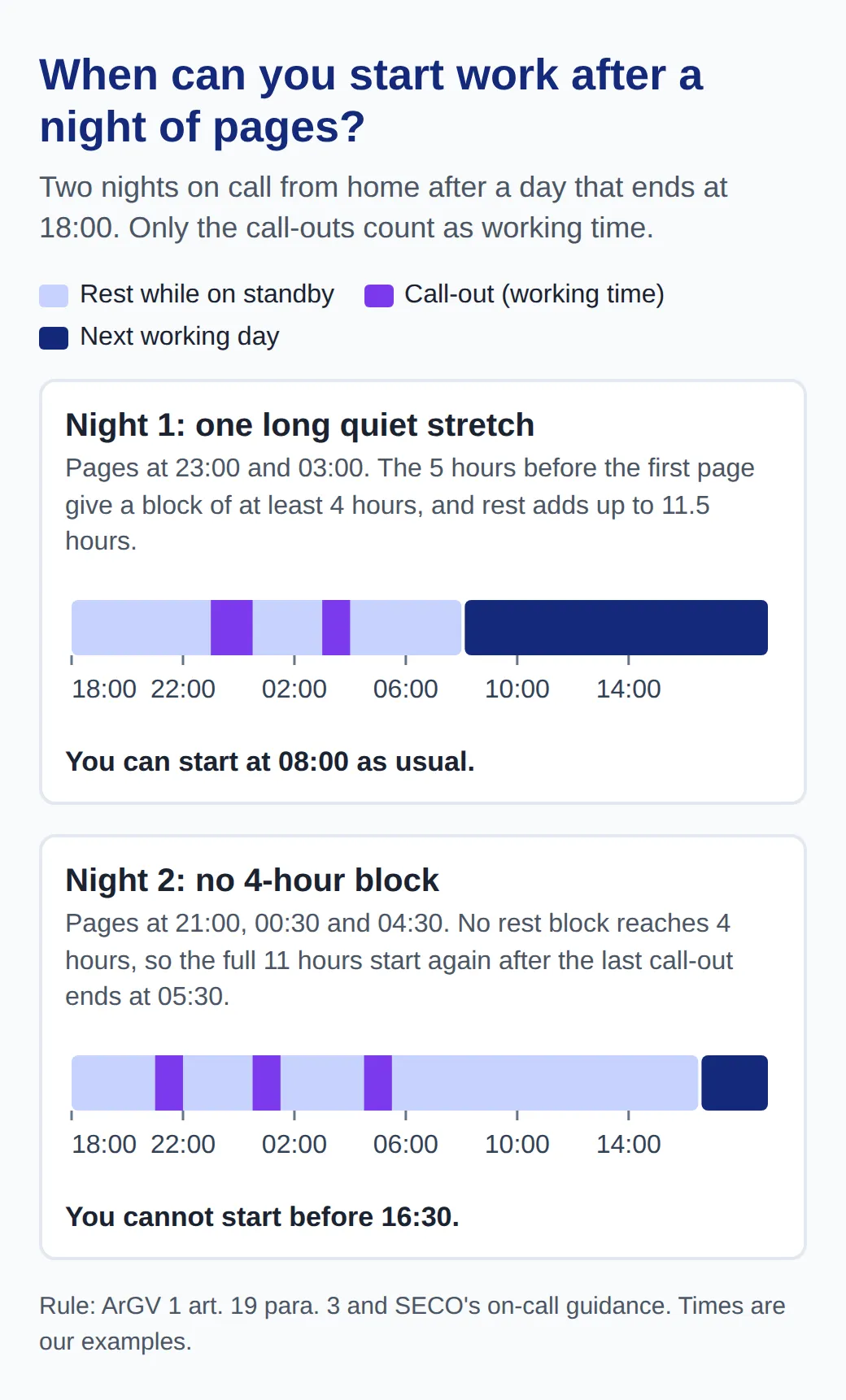
In practice the 4-hour block decides your morning. On the first night above, the five quiet hours before the first page are enough, and the rest adds up to more than 11 hours, so you can start as normal. On the second night, three short pages chop the night into pieces of two and a half to three hours. Your next day cannot start before 16:30, and that is a legal limit, not a favour. SECO also points out that this rule only applies to on-call duty away from the premises: on-site standby is working time, so a full 11-hour rest follows it anyway.
If you work for an IT services company on project work, one more rule can change the numbers. Since 1 July 2023, the second ordinance (ArGV 2, art. 32b) lets companies that sell IT products or services to clients stretch the working day of staff on project or deadline work to 17 hours, breaks and overtime included. That applies to work with international teams in other time zones or to urgent, unforeseeable tasks, and daily rest must then be at least nine hours and average 11 over four weeks.
Night and Sunday call-outs: permits and supplements
Night work (23:00 to 06:00 under the standard hours of art. 10) and Sunday work are banned in principle and need a permit (Labour Act art. 16 to 19). SECO says this applies to on-call duty at night, on Sundays and on public holidays too. For developers, an exemption usually covers the incident itself.
Since 1 April 2019, staff with IT and communications tasks may work at night and on Sundays without a permit when it is needed to fix faults on a network or IT system, or for maintenance that cannot be done by day on working days (ArGV 2 art. 32a). SECO's commentary on the ordinances sets the scope. The system must be essential to running the business, such as customer platforms, databases or payment systems, and the fix must not be able to wait until morning or Monday. Analysing the fault counts as part of fixing it, and so does working on a cyberattack that has already happened.
The same commentary also lists what the exemption does not cover. Monitoring or on-call duty meant to prevent possible cyberattacks needs a permit if it runs at night or on Sundays. So does development work: a crunch before a release is not maintenance, though the company can apply for a permit on grounds of urgent need. Swapping users' laptops and screens should happen in normal working hours.
Whatever the permit situation, the pay supplements stay. SECO's guidance says that if you are called out at night or on a Sunday, you are owed the legal supplements. Temporary night work carries at least 25% extra pay (Labour Act art. 17b), temporary Sunday work 50% (art. 19 para. 3). Sunday work also earns time off: up to five hours is made up with free time, more than five hours with a replacement rest day of at least 24 hours (art. 20). Your employer also needs your consent to have you work at night or on a Sunday (art. 17 para. 6 and 19 para. 5).
Sundays on call have a quirk. If you are on call away from the premises on a Sunday and nothing happens, you are not owed a replacement rest day, but SECO says that Sunday does not count as a free Sunday either. Since at least one full Sunday in two must be free (art. 20 para. 1), you cannot be on call every weekend of the year.
Does your employer have to pay for standby?
Yes. The Labour Act says nothing about pay, but the Federal Supreme Court ruled in 1998 that standby time away from the workplace is work that is paid for, even when you are just waiting (BGE 124 III 249). The case was about a labourer at a rebar company, and SECO cites it as the general rule for on-call pay.
The same ruling sets the limits. Because your employer gets less out of standby than out of your real work, and you can use the time for your own things, standby does not have to be paid at your normal rate. If neither your contract nor a collective agreement sets an amount, the employer owes what is usual, and if that cannot be established, a judge decides what is fair. Standby pay may also be included in your salary. The court left open whether a contract must then state clearly which part of the salary pays for it.
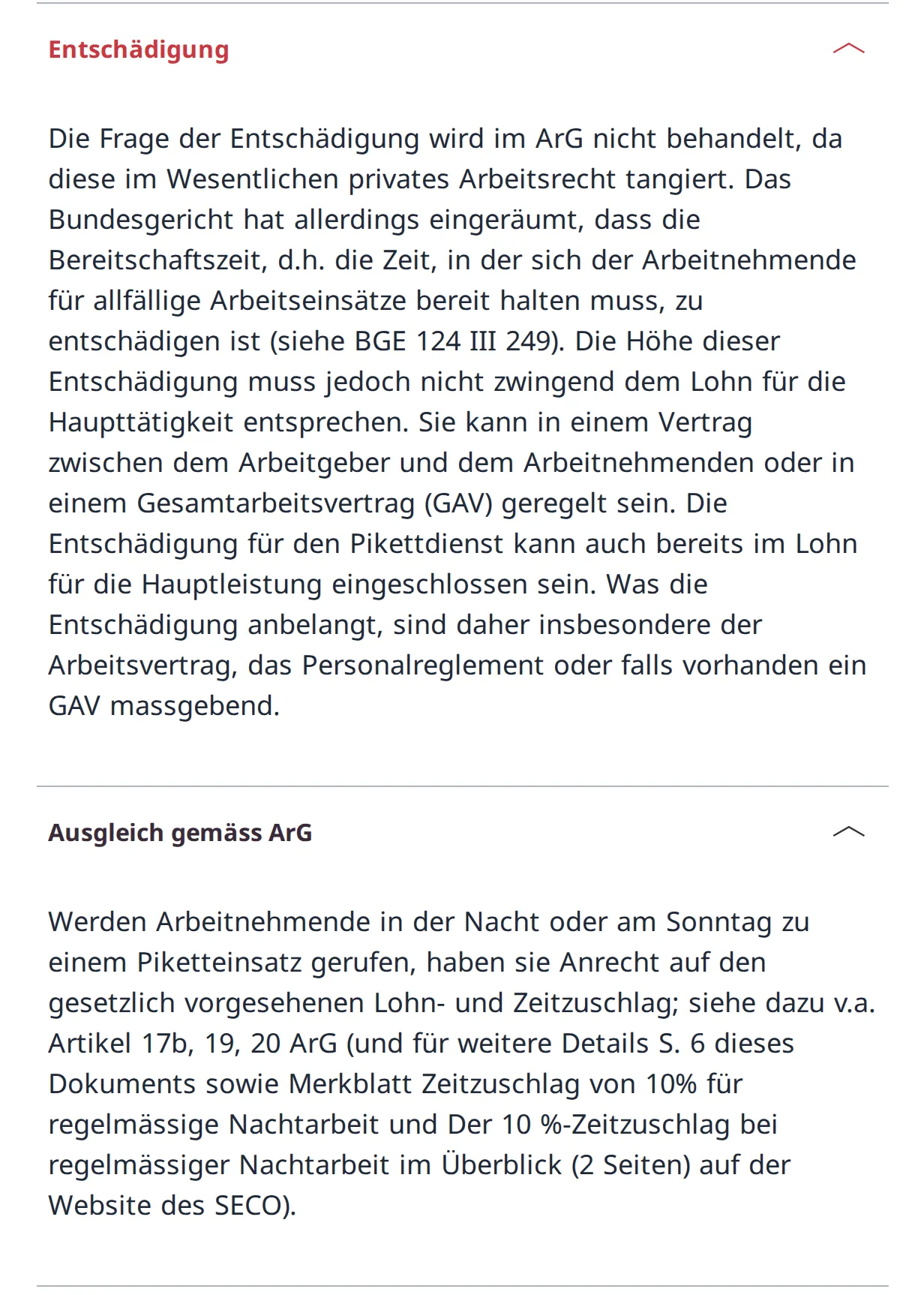
That is the gap you negotiate in. For private employers, the IT industry association Swico publishes a model on-call policy for IT companies. It splits pay into a flat amount per weekday duty and per weekend or holiday duty, plus your hourly wage for every hour of call-out including travel, with the 25% night and 50% Sunday supplements on top. Swico leaves the flat amounts blank, as "CHF xy". Its model shifts run from 17:00 to 08:00 on weekdays and 08:00 to 08:00 on weekends.
What standby pays in practice
No private-sector rate is published that we could check, but public employers publish theirs. They are only examples, and none of them binds a private company. Still, they show what a week on call is worth to employers who had to write the number down.
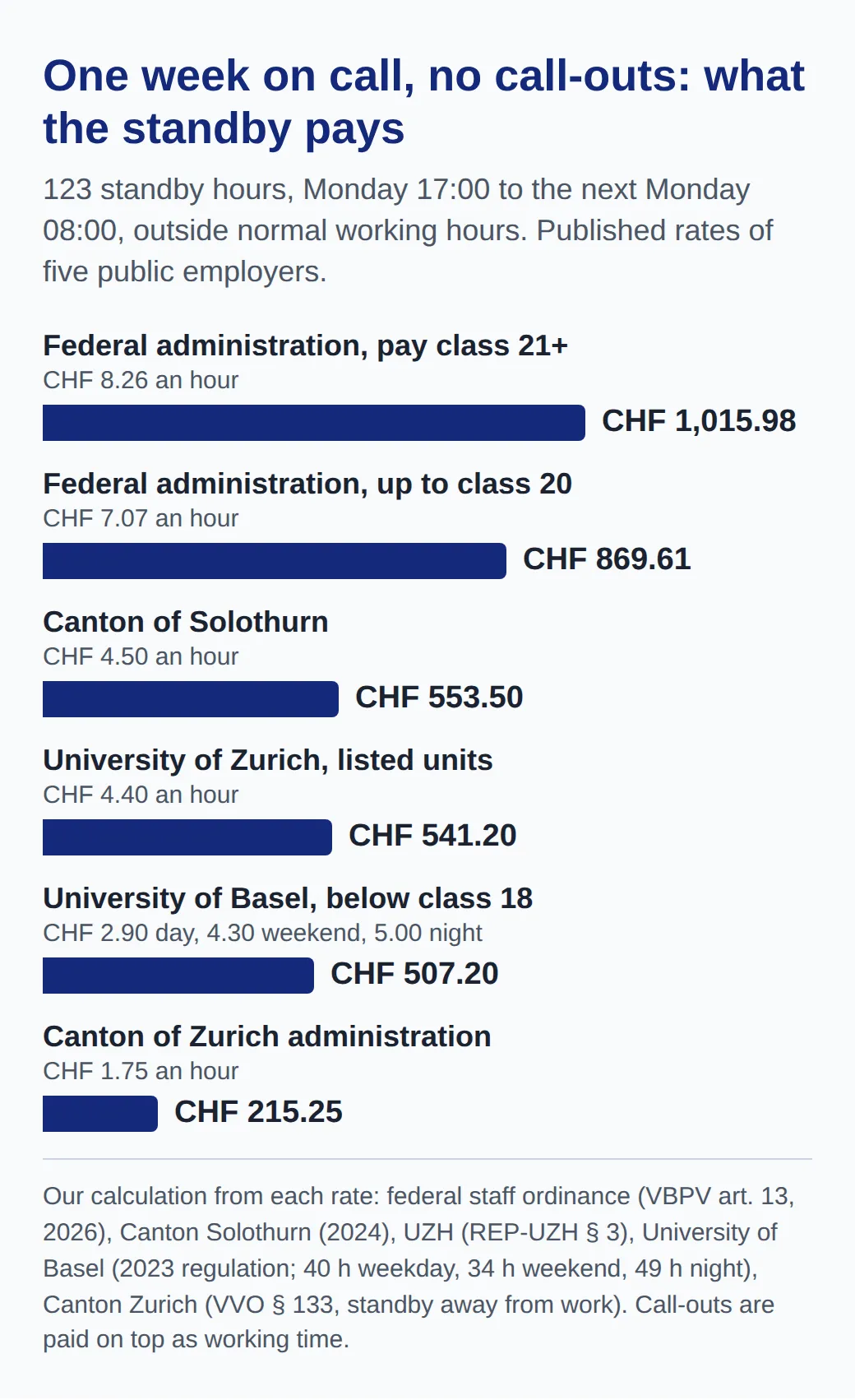
Of the five, the federal administration pays most. Its staff ordinance (VBPV, art. 13, rates in force since 1 January 2026) sets CHF 7.07 an hour up to pay class 20 and CHF 8.26 from class 21. Instead of that rate, a unit may give a 10% time credit plus CHF 1.39 an hour. And where on-call duty does not limit your freedom to move around, the rate may be cut by up to 70%. That last rule is a good way to think about any offer: the more the rota ties you down, the more it should pay.
The universities and cantons pay less. The University of Zurich pays CHF 4.40 an hour in the units it has listed for on-call duty, and treats call-outs as ordered overtime, with a 25% supplement up to pay category 16, according to its HR fact sheet. It counts a call-out from the moment you are called until you get home. The University of Basel pays CHF 2.90 an hour on weekdays, 4.30 at weekends and on holidays, and 5.00 at night, nothing from pay class 18 up, and counts at most 30 minutes of travel. The Canton of Solothurn raised its rate from CHF 2.50 to 4.50 an hour from 1 January 2024. The Canton of Zurich's own administration pays CHF 1.75 an hour for standby away from work and 3.00 for presence at work, under its staff ordinance (§ 133).
To put the federal rate in the context of a developer's pay, see our guide to software engineer salaries. A week on the Swico shifts at CHF 8.26 an hour comes to about CHF 1,000 before any call-out. The federal wage survey puts the 2024 median for ICT specialists at CHF 9,949 a month, so a week of standby at the best federal rate is worth roughly two working days' pay.
Public employers write their own rules
The Labour Act does not apply to federal, cantonal and municipal administrations (art. 2), and only in part to some public institutions, so these employers set on-call rules in their own staff law. Several copy the Labour Act's limits anyway. The federal ordinance applies ArGV 1 art. 14 and 15 directly, and the Zurich and Basel university rules repeat the seven-days-in-four-weeks cap almost word for word. Inside a private company, the Act also leaves out people in a senior management role (art. 3), which the ordinance defines as having far-reaching decision powers that shape the structure and development of the business (ArGV 1 art. 9). In our reading, a team lead or a staff engineer rarely fits that.
What to ask before you join a rotation
The law gives you the frame, and your contract or the company's staff rules fill in the money. Ask before you sign, ideally at the offer stage, which our guide to tech interviews covers. Six questions decide whether a rota is fair: where you wait and how fast you must respond, how many people share the rota, what the standby pays, how call-outs are paid and rounded, when you may start after a bad night, and how call-outs are recorded.
Recording matters more than it sounds. Even where a company uses simplified time recording, the start and end of night and Sunday work must still be documented (ArGV 1 art. 73b), and the University of Zurich asks its staff to log both standby and call-outs. Keep your own log of every page, with the time you started and stopped.
A short message to the hiring manager or HR does the job:
Before I accept, could you send me the on-call rules for this role? I would like to know how many people share the rota and how many days a month I would be on call, the expected response time and whether I can respond remotely, the standby pay per day or hour, how call-outs are paid (hourly rate, night and Sunday supplements, minimum per call), and how rest is handled after a night with call-outs.
If the answer is "it's included in your salary", ask them to state in the contract which part of the salary pays for standby, and how many on-call days a year that part assumes.
Open DevOps and developer jobs
If an ad mentions on-call duty, the questions above are fair to ask in the first interview. The federal administration, the best payer in our comparison, is based in Bern, and our Bern software engineering board lists the developer jobs there.
Common questions
- Does a five-minute phone call while on call count as working time?
- Yes, but under the Labour Act only the time you actually work counts, so five minutes is five minutes. A minimum per call-out comes from your contract or staff rules, not from the law. The University of Zurich, for example, pays phone consultations by duration with a minimum of half an hour.
- Can my employer put me on call without asking?
- Your employer can plan on-call duty within the legal limits, but it must involve staff in planning it and should, as a rule, announce the rota at least two weeks ahead. The Labour Act also says an employer may not make you work at night or on Sundays without your consent. If you have family duties, short-notice changes to the rota need your agreement.
- I work part time. Can I be on call as often as a full-time colleague?
- The legal cap is the same for everyone: seven days in four weeks, or 14 by exception. Some employers go further. The University of Basel, for example, limits on-call duty for part-time staff to their share of a full-time job.
- Is on-call pay part of my salary for the pension fund?
- It depends on your pension fund's rules on which pay is insured. The University of Zurich states that pension contributions are due on on-call payments, which is one public example. Check your fund's regulations or ask HR before you count on it.
More posts
All posts
Salary Increase in Switzerland for 2027: What IT Staff Get
Swiss firms plan raises of 1.2% for 2027 and unions want up to 2.5%. The IT and telecom figures, how raise budgets are split, and how to make your case.

Intellectual Property in Swiss Employment Contracts, 2026
Who owns the code, inventions and side projects you make as an employee in Switzerland, what IP clauses say, open source, and when a non-compete binds.

Tech Jobs in Switzerland Beyond Zurich: Five Hubs in 2026
Tech jobs in Switzerland outside Zurich: who hires developers in Bern, Geneva, Lausanne, Zug and Basel, and what rent and health insurance cost in each.