Software Engineer Interviews in Switzerland: How They Run

In one minute
Swiss tech employers mostly run four to six steps: an application, a screening call or culture check, one technical test or interview, a round with the team or senior people, and for some roles references or a background check before the offer. The coding part is usually a short online challenge or a long technical interview, not a multi-day take-home. Your notice period then decides when you start.
That is what the companies themselves publish. Much of what you find on this question comes from anonymous interview reviews by one or two candidates. We read the hiring pages of nine employers that hire developers in Switzerland instead: Swisscom, SBB, PostFinance, Raiffeisen, UBS, Galaxus, Zühlke, Adnovum and Nexthink. We added the federal rules that shape the end of the process, on references, background checks and notice. Below is what each step looks like, what it costs you in hours, and where the law gives you a say.
What the published processes have in common
Most companies describe four to six steps, and they look alike more than they differ. There's an application, a first conversation, a test or a technical interview, one more round with the team or senior people, and an offer. Swiss employers rarely publish the content of their technical rounds, but several publish their order and length.
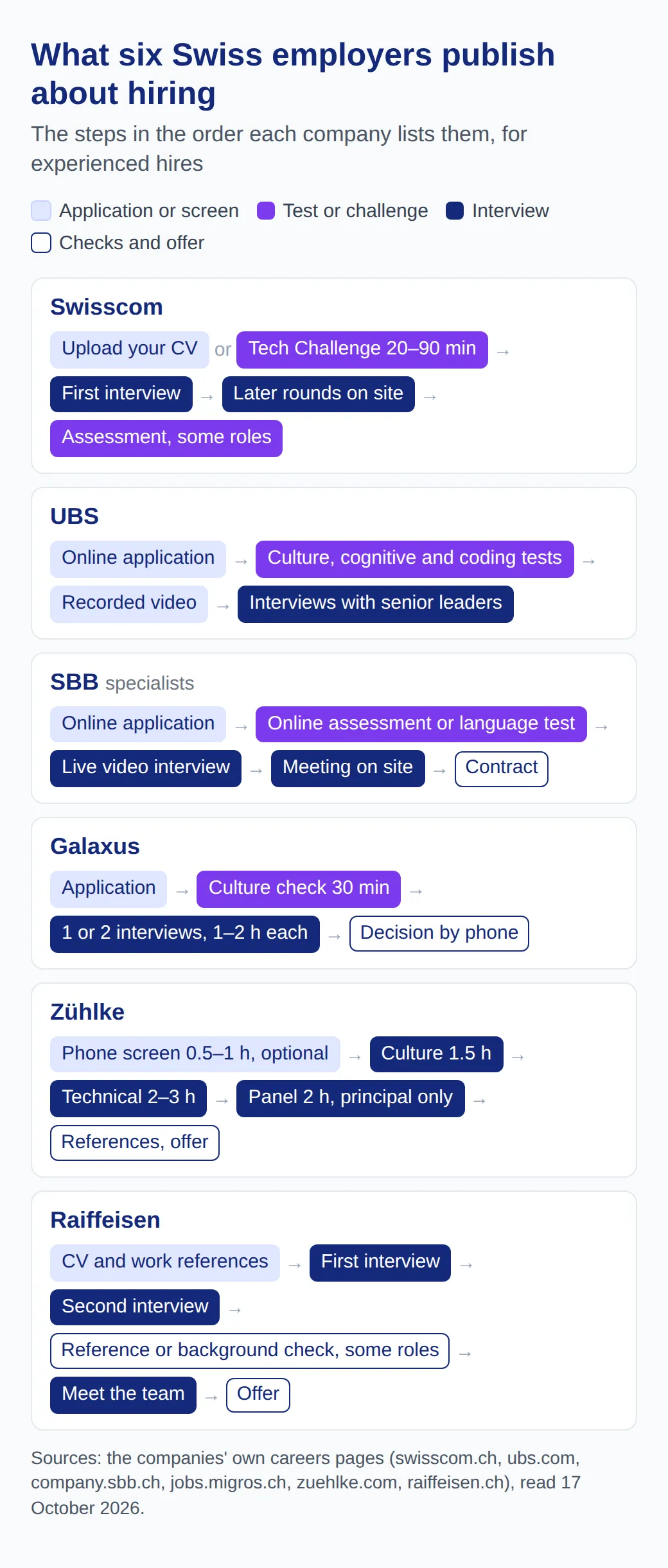
Tests tend to come early, before you meet anyone: Swisscom, UBS and SBB put an online challenge or assessment near the start. At the consultancies the technical judgment happens in an interview instead: Zühlke and Adnovum each describe a dedicated technical interview. Checks come at the end. Zühlke lists a reference check together with the offer and contract, and Raiffeisen may check references or run a background check depending on the role.
The process is also shorter than its reputation. Adnovum's page for Switzerland says the whole thing usually takes two to three weeks: a phone screen, a cultural and personal fit interview, and a technical interview on your skills and seniority, in an order that can change with the role. A company that hires through a single technical conversation can move fast. One that adds an assessment day takes longer, so the first reply is a good place to start measuring.
How long until you hear back?
Within two to three weeks, where companies commit to a number at all. Swisscom's application page promises a reply within 15 working days. SBB says you hear back at the latest two weeks after applying, or one week after the application deadline. PostFinance reviews your file with the future manager and tells you the next steps within a maximum of two to three weeks.
Silence beyond that window is a signal worth acting on. Both Swisscom and SBB let you follow the status in your candidate profile, so check there before you chase anyone. If the status still hasn't moved after the promised time, one short email to the recruiter is a normal step.
Some details at this stage save you trouble later. Galaxus, on its careers page within the Migros group, says it does not consider applications sent by email, and a cover letter is optional. PostFinance and Raiffeisen ask for your work references with the CV, which brings us to a Swiss habit that surprises newcomers.
Your work certificates go in with the CV
In Switzerland, a written reference from each past employer, the Arbeitszeugnis, is part of a normal application. Raiffeisen asks for one PDF with your CV, certificates and work references, and says a cover letter is not needed. If you come from a country without this tradition, send what you have instead: a recommendation letter, or a confirmation of your role and dates. The rules for the Swiss version come further down, with references.
The first conversation is about fit
Expect your first live contact to be a recruiter or a manager asking why you want the job, not a coding question. Zühlke's Swiss careers page starts with an optional phone screening of half an hour to an hour, followed by a cultural assessment interview of 1.5 hours. Adnovum opens with a phone call to clear preliminary questions, then a cultural and personal fit interview. Raiffeisen's first interview can be online or on site, and its second one covers team fit plus the practical terms: conditions, place of work and the percentage you'd work.
Some employers test fit with a tool before any person sees you. Galaxus starts with a cultural assessment that takes about 30 minutes and can be done anywhere. UBS lists a Culture Match Assessment built on hypothetical work scenarios, plus numerical, verbal and logical reasoning tests, on its hiring page. Most UBS roles may also include a recorded video interview, where you get the questions and record your answers when it suits you.
Swisscom has the most unusual format. Besides phone, video and face-to-face interviews, its agile teams sometimes invite you to a "Speed Dating" session, a conversation together with other candidates. If you're invited to one, prepare as you would for a team interview, with other candidates taking part.
Language matters here too. Nexthink, which names Lausanne among its main R&D regions, encourages you to send your CV and application in English. Its process may start with a phone call, move to a video call on Microsoft Teams, and end with an in-person meeting where it has a local hub. Once fit is settled, the technical round decides most offers.
Take-home or live coding?
Swiss employers lean towards short online challenges and long technical conversations. None of the nine pages we read describes a take-home project that runs for days. The formats they do publish:
- Swisscom: you can apply with a CV, or prove yourself through the Tech Challenge, an IT skills test the page puts at 20 to 90 minutes. Which options you get depends on the job.
- UBS: technology roles may get a coding challenge, solved "in a native coding environment with real-time feedback".
- SBB: specialists get an online assessment or a language test, with detailed feedback, before a live video interview and a meeting on site.
- Zühlke: a technical and professional assessment of two to three hours, the longest technical step any of these companies puts a number on.
- Galaxus: one or two interviews of roughly one to two hours each with team leaders and future teammates.
Zühlke's own recruiters explain what that long session is for. In an article on interviewing there, where two of its recruiters in Singapore and Belgrade answer questions, one says: "We don't just set a code test; it's not just about sitting you down to program." The same recruiter adds that the interviews are very interactive and that full marks are not what they look for. Expect a conversation about how you think and work, with some code along the way.
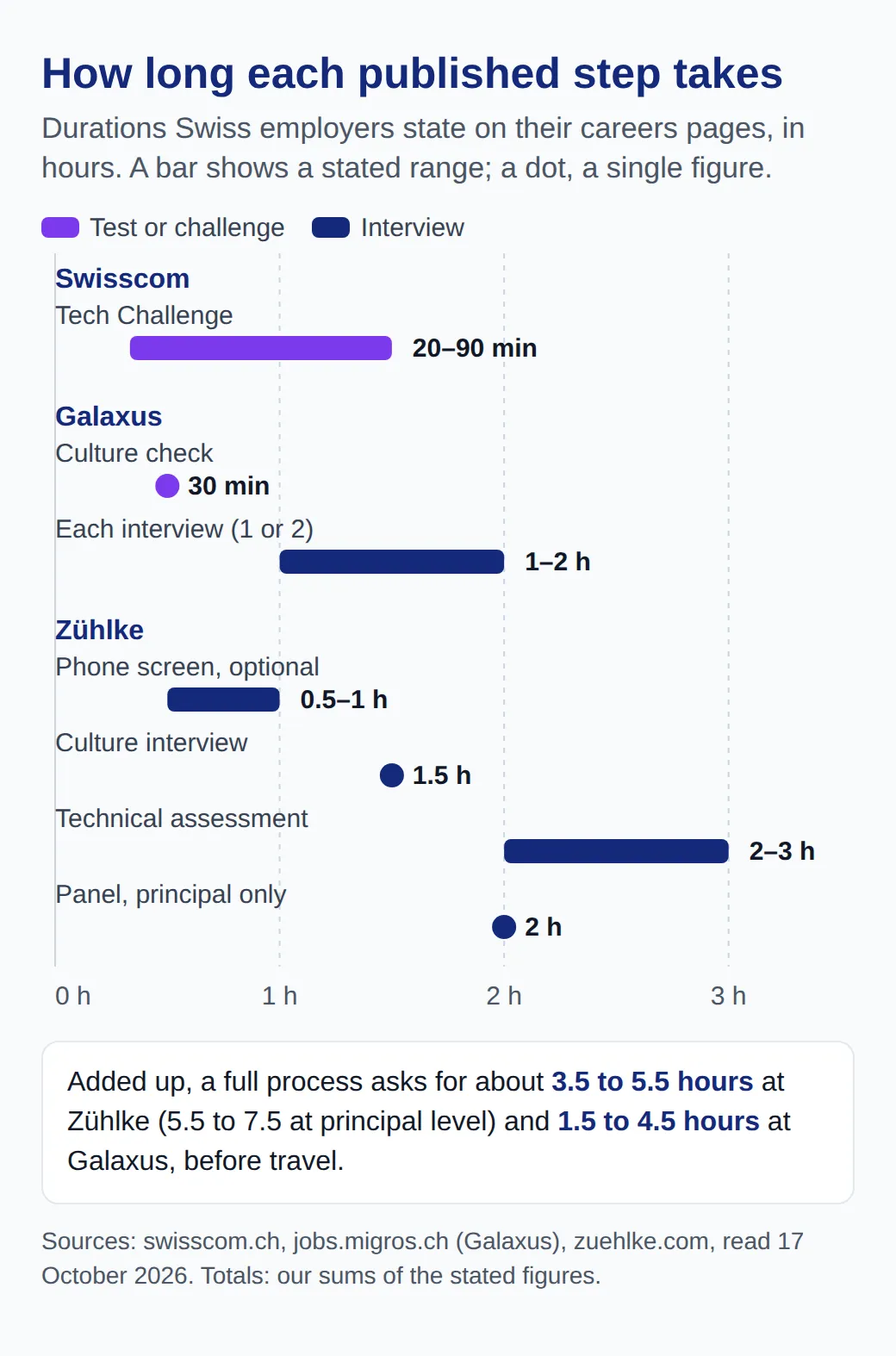
Add those figures up and the whole thing is smaller than many developers fear. A full Zühlke process asks for about 3.5 to 5.5 hours of your time below principal level, and Galaxus between 1.5 and 4.5 hours, travel not included. That makes it realistic to run two or three processes at once while you're still employed, as long as you schedule the long rounds well.
Trial days and unpaid work
A trial day is a different matter from a test, and the law treats it that way. Swisscom offers an Experience Day, where you spend half a day or a full day on site shadowing someone from the team. Shadowing is watching. Real work is not.
The labour court of Zurich set out the rule in a 2019 judgment (AH190018-L). Trial work is allowed and as a rule unpaid, but only if both sides agreed before it started that it would be unpaid. Without that agreement, the court presumes it is paid work and treats it as an employment relationship, with pay owed at the agreed or usual rate. So if a company asks you to build something real for it, ask in writing beforehand whether it's paid. A clear answer protects both of you.
Senior roles add a panel
The more senior the job, the more people you meet and the longer the last round. Zühlke adds a two-hour panel assessment for principal-level hires only. Swisscom invites candidates for certain positions to an assessment, usually late in the process, which can take from a few hours to a full day. SBB sends managers to an assessment centre with exercises and work simulations. At UBS, the final stage is a series of interviews with senior leaders.
None of these pages uses the phrase "system design". That doesn't rule the topic out, but no company here commits to a whiteboard design round in writing. Ask on the first call what the senior round covers, who sits on the panel and whether there's anything to prepare. The answer tells you whether to brush up on distributed systems or on how you'd lead a team through a migration.
When the panel says yes, the last checks begin.
References, certificates and background checks
Before an offer, many Swiss employers check your past. Zühlke lists a reference check together with the offer and contract as its final step. Raiffeisen says that, depending on the role and level, it may check references, run a background check or invite you to an assessment centre. You have more control over this step than you might think.
No call without your consent
A company may not phone your current or former boss on its own. The Federal Data Protection and Information Commissioner says an employer needs your consent before it asks third parties, such as current or former employers, about you. Those employers may share only what is relevant to the new job, mainly your performance and conduct. They may not open your personnel file to the caller, and they may not disclose the terms of your contract, because that could weaken your position in the negotiation.
The same page limits what you can be asked in an interview. Questions about your training, career and plans are fine. Questions about income, debts, illness or pregnancy are allowed only where the job gives a special reason.
If a recruiter asks for referees early, you can give names and still keep your current employer out of it until you've signed. A short reply does it:
Happy to share two references from my previous role: [name, role, email] and [name, role, email]. Please contact my current employer only once we have agreed on an offer. I've attached an interim reference from them, dated [month year].
An interim reference you can ask for any time
That last line works because of a right most newcomers don't know about. Under article 330a of the Code of Obligations, you can ask your employer for a reference at any time, during the job as an interim reference (Zwischenzeugnis) or at the end. The SECO's FAQ on references explains that it must be truthful and kindly worded, and that coded phrases are not allowed. You can also ask for a simple confirmation of your role and dates instead of a full assessment.
Debt and criminal record extracts
Some employers ask for two official extracts. Raiffeisen, a bank, asks for a debt enforcement extract (Betreibungsauszug) and a criminal record extract (Strafregisterauszug), and lets you send them after you've signed. Both are cheap and quick to get. The criminal record extract costs CHF 17, ordered online from the Federal Office of Justice or at any post office counter. The debt extract comes from a debt enforcement office: in Basel-Stadt, for example, it costs CHF 17, or CHF 18 with delivery, and online orders are handled within 48 hours on working days.
Jobs that touch sensitive federal systems go further. Staff of companies working in security-sensitive roles for the federal administration or the army need a personnel security check, which needs their written consent. The vetting office's page for companies says a basic check usually takes up to one month, an extended check without an interview two months and with one four months. It adds at least two months if you lived abroad for more than three months in a row during the last five years, which hits many newcomers. If the job ad mentions a security clearance, ask how it fits your start date.
The offer, the contract and your notice period
Offers usually come by phone first. Galaxus calls you after the interviews, PostFinance confirms by phone, then by email, and sends the contract in the days after. Raiffeisen discusses the details by phone and asks you to return the signed contract within one working week. Read it closely within that week: probation, notice periods, any clause on your own projects.
Then the old contract decides when you can start. The legal default, as the SECO's FAQ on dismissal sets out, is one month's notice in your first year of service, two months in years two to nine and three months from year ten, each running to the end of a month. A written contract can set other periods, and many developer contracts do. What counts is the day your letter reaches the employer, not the day you post it.
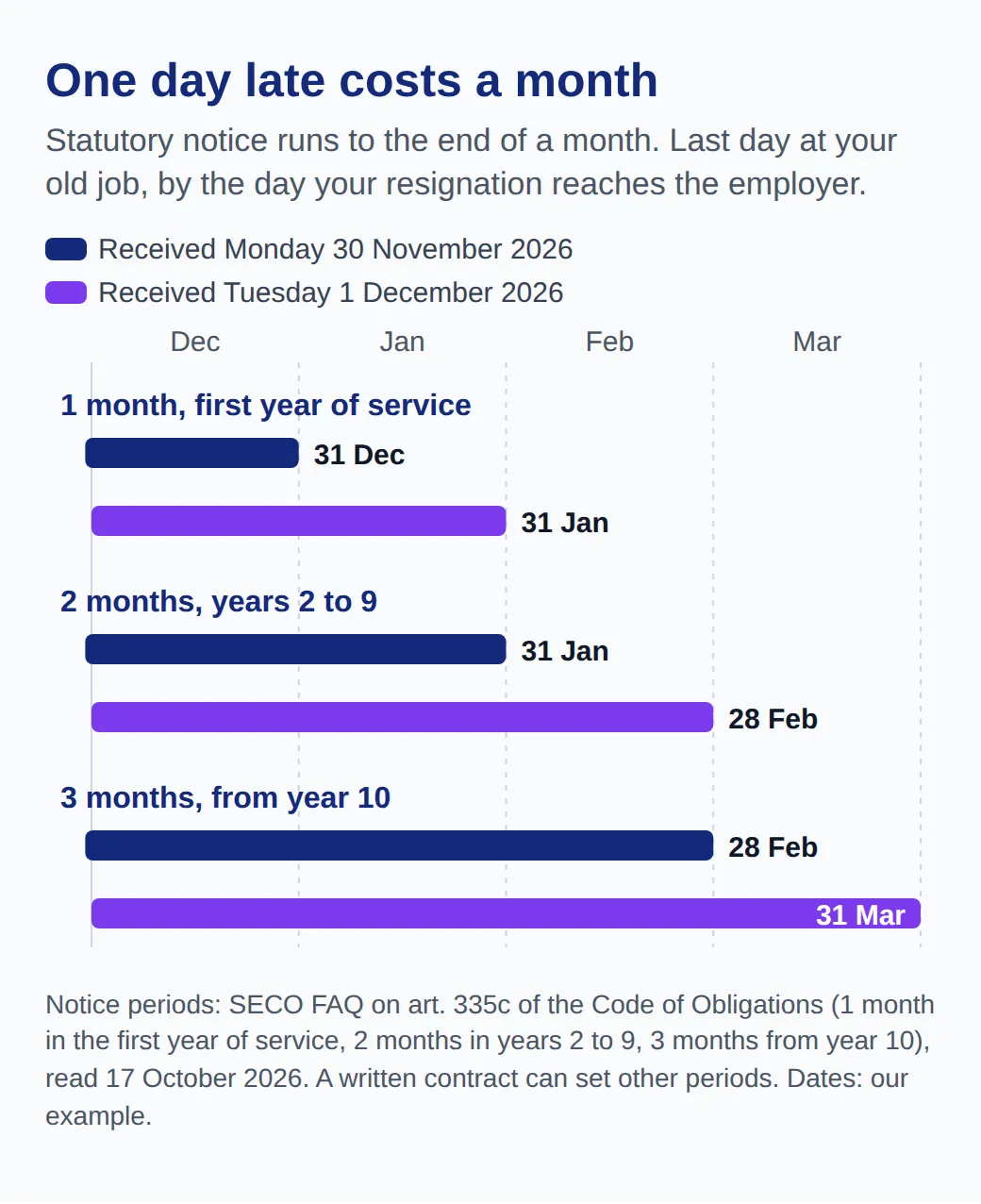
That's why timing matters at the end of a process. If your offer lands in the last days of a month, a resignation that arrives one day too late moves your start date by a whole month. When you agree a start date, give them the date your notice actually ends, not a guess.
Probation works in your favour at the new job too. Unless the contract says otherwise, the first month is a probation period, and it can be extended to at most three months in writing. During probation either side can end the contract with seven calendar days' notice.
If you need a work permit from outside the EU and EFTA, one more step sits between signing and starting. Your employer has to apply for it, and your start date waits for the decision. We explain how that works in our guide to the Swiss work permit for non-EU developers.
Before your first call with a recruiter
Use the first call to get the process in writing. Ask how many rounds there are and how long each one takes, whether there's a coding challenge or a technical interview, and who you'll meet. Ask when they plan to check references, and say which of your employers they may contact and when. If there's any trial work, ask whether it's paid. And tell them your notice period early, because it shapes their plans as much as yours.
Know your number before the money question comes. Our post on software engineer salaries in Switzerland shows what developers earn by role and region. And if you're weighing a contract role against a permanent one, our guide to freelancing as a developer covers how that side works.
Open developer jobs in Bern and Zurich
Zühlke's Swiss careers page welcomes you to its offices in Zurich and Bern, and both cities have developer roles listed on our boards.
Common questions
- Can an interviewer ask what I earn now?
- The Federal Data Protection and Information Commissioner lists income among the topics an employer may ask about only when the job gives a special reason, next to debts, illness and pregnancy. In practice you can answer with what you expect instead. Most employers ask for your salary expectation anyway, and that question is ordinary.
- What happens to my documents if I am turned down?
- The employer has to return them or destroy any copies, unless it has a reason to keep them. The data protection commissioner says application data may be kept for up to three months after the rejection, so the company can defend itself against a discrimination claim. With your consent it can keep them longer for a future opening.
- How do I spot a fake recruiter?
- Check the sender's domain and the channel. Nexthink, for example, says its recruiters write only from its own email domains, never make an offer by text or messaging app and never ask for a fee. A real Swiss employer does not charge you to apply, and an offer that skips any interview is a warning sign.
- Will I get feedback if I am rejected?
- Some employers promise it. Swisscom says you get direct, traceable and constructive feedback in every case, and SBB gives detailed feedback on its online assessment. Others say nothing about it, so ask the recruiter on the first call whether feedback is part of their process.
More posts
All posts
Intellectual Property in Swiss Employment Contracts, 2026
Who owns the code, inventions and side projects you make as an employee in Switzerland, what IP clauses say, open source, and when a non-compete binds.

Junior Developer Jobs in Switzerland: Four Routes In (2026)
How to get a junior developer job in Switzerland: apprenticeship, HF, university or bootcamp, with 2025 graduate numbers and what 16 junior ads asked for.

Freelance Developer in Switzerland: AHV, VAT, Pensions 2026
Freelancing as a developer in Switzerland: why one client can make you an employee, staffing firms, the CHF 100,000 VAT line and pillars 2 and 3a.