Junior Developer Jobs in Switzerland: Four Routes In (2026)

In one minute
There are four doors into a first developer job in Switzerland: a four-year ICT apprenticeship (the EFZ), a college of higher education (HF), a university or university of applied sciences, or a private bootcamp. The apprenticeship is the largest single qualification: 1,695 people finished it in 2025. Of 16 junior ads we read, ten wanted German or French and half asked for a degree.
Swiss junior ads are written in the terms of the Swiss education system, so it pays to know what an EFZ or an HF is before you apply, and which one a given ad is quietly asking for. Below are the four routes with the official numbers from the Federal Statistical Office (BFS), what each costs you in time, and what 16 junior ads on our board asked for in October 2026.
How many new developers does Switzerland train each year?
In 2025 the IT apprenticeship produced more graduates than any single university or college route. The BFS counts every federal diploma and degree, and its tables let you line them up side by side: 1,695 apprentices finished the Informatiker/in EFZ (BFS, vocational qualifications), 450 people earned an HF diploma in computer science and 532 one in business IT (BFS, HF diplomas), the universities of applied sciences awarded 752 bachelor degrees in computer science and 637 in business IT (BFS, FH degrees), and the universities awarded 794 bachelor and 962 master degrees in computer science (BFS, university degrees).
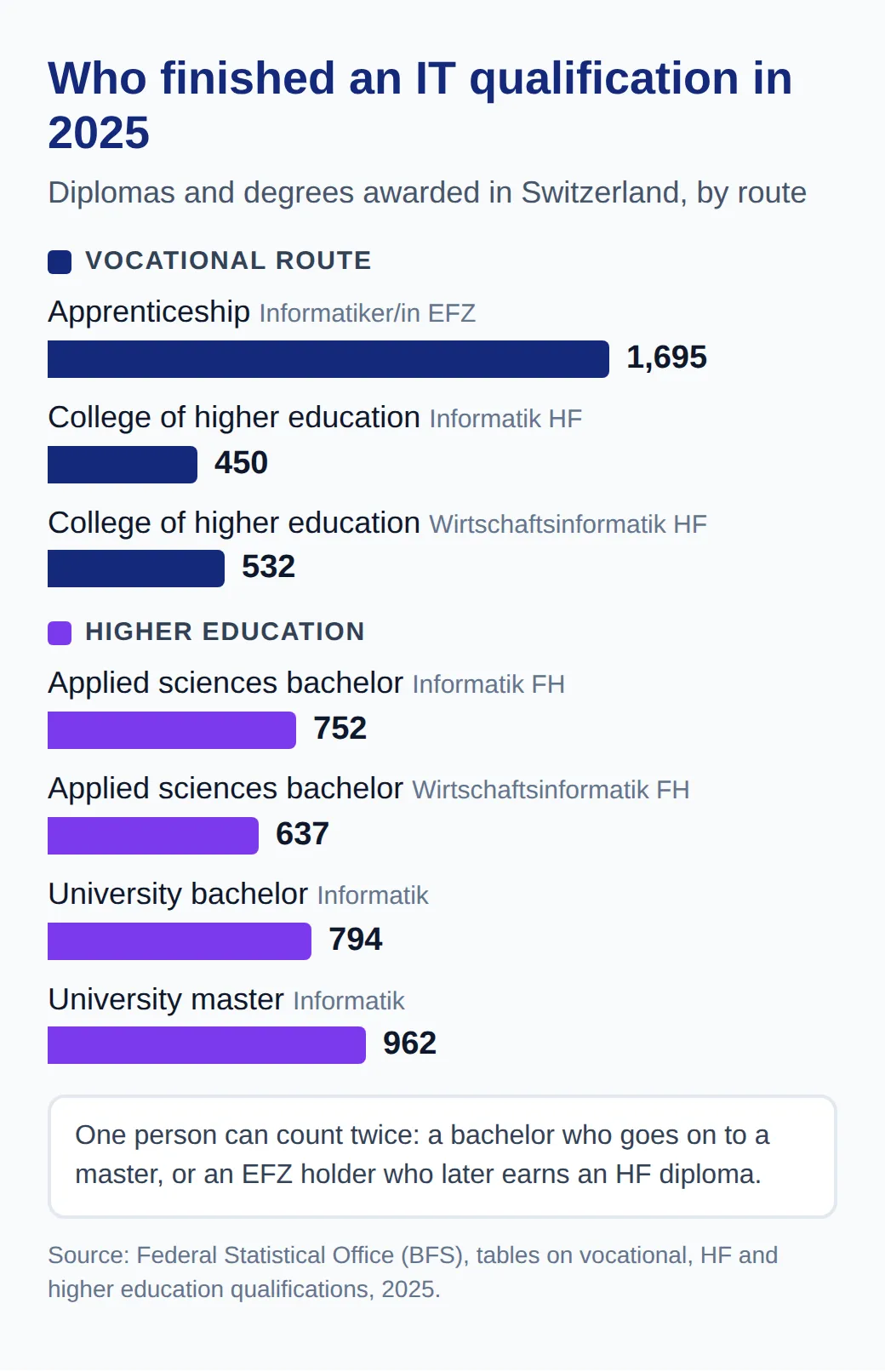
Two things in those tables are easy to misread. The apprenticeship figure fell from 2,111 in 2024 to 1,695 in 2025, but most of that gap is a change of label. With the 2021 reform, business IT left the Informatiker EFZ and became a separate trade, the Betriebsinformatiker/in EFZ, whose 307 graduates in 2025 are counted apart. That trade was short-lived: the SBFI register shows it out of force since the end of 2023, with a transition period for those already in training. And one university stands out: ETH Zurich awarded 332 of the 794 computer science bachelor degrees and 406 of the 962 masters.
The pipeline is still growing. In 2025, 1,190 young people started the application development track of the apprenticeship and 1,044 the platform track, according to the BFS table of new apprenticeships. So the person you compete with for a junior post may well be 19 or 20, with up to four years in a company and a federal diploma. That is where the first route starts.
Route 1: the ICT apprenticeship (EFZ)
The apprenticeship is a four-year paid training that starts after compulsory school and ends with a federal diploma, the EFZ. The careers portal berufsberatung.ch describes the rhythm: three to four days a week in the company, one to two at a cantonal vocational school. You pick one of two tracks. In application development you program software, apps and websites; in platform development you set up IT systems and fix faults. For a developer career, the first is the one to look for.
The official details sit in the occupation register of the State Secretariat for Education, Research and Innovation (SBFI), which is the place to check what a Swiss qualification actually is.
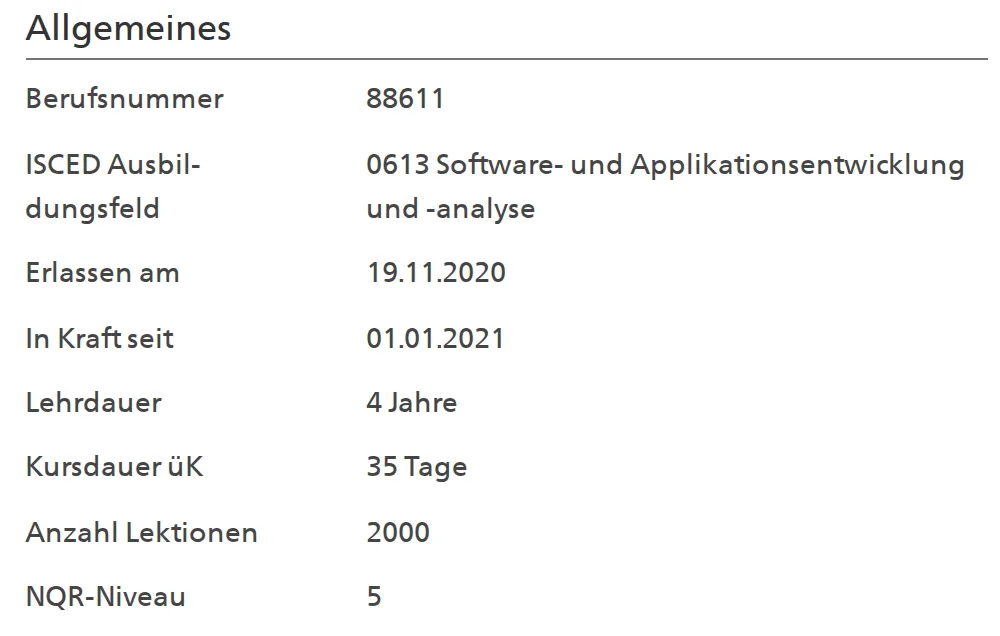
The register entry lists 2,000 lessons of schooling, 35 days of branch courses and level 5 in the Swiss national qualifications framework. It also files the trade under the international education field for software and application development, which is a useful fact when a recruiter abroad asks what the diploma covers.
Not every apprentice works in a company from day one. In 2025, 305 of the 1,695 graduates had trained full-time at school, the rest in the dual model. In the canton of Zurich, the full-time version is the Informatikmittelschule (IMS): three years at school, then one year of work in an IT company or department, ending with the application development EFZ and a vocational baccalaureate. It follows the third year of secondary school and charges no tuition to residents of the canton. You get in through the central entrance exam, held once a year at the end of October, and you need a Multicheck aptitude test for IT to register for it.
That vocational baccalaureate (Berufsmaturität) matters more than its dull name suggests. Under the Higher Education Act (art. 25), it opens a university of applied sciences to you when you combine it with an EFZ in the field you want to study. Apprentices with very good school results can take it alongside the training. Since 2023 there is also a newer four-year trade, the Entwickler/in digitales Business EFZ, which automates processes and builds digital products for companies; 169 apprentices started it in 2025.
Route 2: the college of higher education (HF), while you work
The HF is the route for people who already work in IT and want a higher qualification without stopping. It is a tertiary diploma that you often earn part-time, next to a job. The Zurich vocational school TBZ is a typical public example: its HF in computer science runs for six semesters, with one full day on site and two evenings of remote classes a week, and costs CHF 3,300 per semester. You need an EFZ in the field, and a job of at least 50% in IT while you study. Other qualifications can get you in after a review of your file.
The result is the title dipl. Informatiker/in HF, and junior ads know it. A firmware post in Horgen asked for "HF/FH", and the web agency Stutz Medien in Wädenswil named HF and FH next to the apprenticeship. Digitec Galaxus asked for "Höhere Fachausbildung im Bereich Informatik", higher education in computer science, in both its junior ads, and named ETH, universities and FH in one of them.
There is a shorter option too. The federal certificate (eidgenössischer Fachausweis) for ICT Application Development Specialists is prepared in modules over one to one and a half years, usually next to a job, with a focus on frontend, mobile, backend or data engineering, according to berufsberatung.ch. The admission rules are in the exam regulations, so read them before you pay for a course. It suits someone who already works as a developer and wants the paper to match.
The HF and the certificate both assume you are already in the trade. If you are not, the third route starts in a lecture hall.
Route 3: university of applied sciences or university
A university of applied sciences (FH) gives you a practice-oriented bachelor, and a university or ETH a more theoretical one; most of the ads in our sample that name a degree accept either. The doors differ. Under the Higher Education Act (art. 25), an FH takes holders of a vocational baccalaureate with an EFZ in the field, or holders of an academic baccalaureate (gymnasiale Matura) with at least one year of work experience in a related occupation. Universities and the federal institutes of technology take baccalaureate holders directly (art. 23).
For a gymnasium leaver, that year of work is often an internship, so an FH graduate comes out with at least one year in a company on the CV. In 2025 the FH side trained more bachelors: 1,389 in computer science and business IT against 794 university bachelors in computer science. The university side then grows again at master level, with 962 degrees.
If you studied in Switzerland on a student permit from outside the EU and EFTA, your degree carries one extra right. The Foreign Nationals and Integration Act (art. 21 para. 3) gives Swiss university graduates six months after their studies to find suitable work, and lets them be hired without the usual test of whether a Swiss or EU candidate was available, as long as the work is of high academic or economic interest. The rest of the permit process is in our guide to work permits for non-EU developers.
Bootcamps and career changers
A bootcamp gives you skills and a portfolio, but not a federal qualification, so on its own it rarely meets an ad that names a degree. The SDBB's education map for ICT, published by the body that runs the national careers portal, puts private certificates such as CompTIA or SIZ in a column of their own, apart from the federal diplomas.
The part that is easy to miss: Swiss law gives adults a back door to the real thing. The Vocational and Professional Education and Training Act says that "access to qualification procedures shall not be contingent upon attendance of specific courses of study" (art. 34 para. 2), and for an apprenticeship the qualification procedure is the final exam. The ordinance sets the condition: if you learned the trade outside a regulated course, you need at least five years of work experience to be admitted (art. 32). You do not need to have done the apprenticeship to sit its final exam.
For the Informatiker EFZ there is now a second way. The SBFI register lists a validation procedure for this trade, valid since 22 August 2025, in which you document what you can already do instead of sitting the full exam. According to berufsberatung.ch, you need at least five years of work experience, two to four of them in the target occupation, and the dossier takes about 250 hours. Access to the dossier tool costs CHF 90, and the canton that runs the procedure usually pays part or all of the costs. Ask the office for adult vocational qualifications in your canton of residence (Fachstelle Berufsabschluss für Erwachsene) whether it runs the procedure for IT; if it does not, you can use another canton's. In German-speaking Switzerland the dossier is written in German.
Meanwhile, look for employers who say plainly that they hire career changers. In our sample two did. The software firm greenSys in Hägendorf, in an ad that has since closed, wrote that you "can be a career changer, fresh from training, or come from an adjacent field", asking only for basic HTML, CSS, JavaScript, Git and SQL. A Geneva fiduciary firm hiring a junior software architect through an agency wrote that "your potential and your achievements count more than your degree" and invited a portfolio or GitHub profile. Both quotes are from our English translation of the ads.
What junior developer ads actually ask for
We read every ad with "junior" in the title on our board in mid-October 2026, merged duplicates and left out one research post. That left 16 ads, and the pattern is clear: language and a named qualification are the two big filters, and a "junior" title does not always mean a beginner.
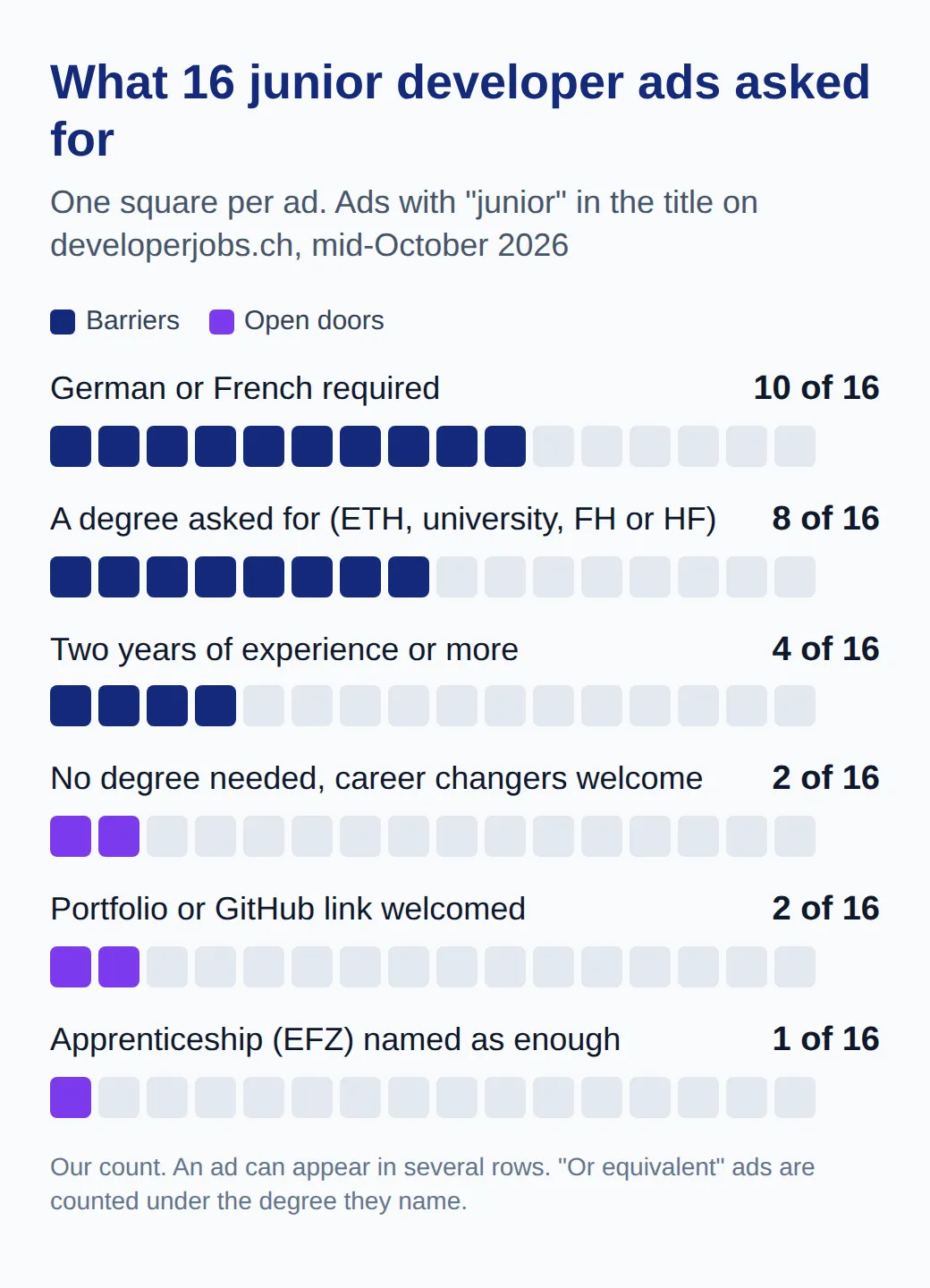
Language came first. Ten of the 16 asked for German or French, and most put a level on it: C1 German at Digitec Galaxus, B2 at the outdoor advertising firm APG|SGA in Zurich, "business fluent" for a frontend role in Bern. Even the blockchain firm Blockstream, which advertised in English with Lugano as the location, required Swiss German and German. Both Geneva ads that named a language asked for French. Only two ads asked for English and nothing else, and each wanted more than a beginner brings: a private bank in Zurich required a certification in its core banking software, and a Zurich telecom firm wanted two years of PHP.
Experience is where the word "junior" misleads most. Four of the 16 asked for two years or more. Blockstream's "Junior Solutions Architect" listed five to ten years in solution architecture or a related field as a requirement. A Zurich drone maker wanted three years of full-stack work for its junior engineer, and Appnity wanted "several years of professional experience" for a 50% junior developer post in Basel. Read the requirements, not the title: an ad like that is aimed at someone with a few years behind them.
Eight ads asked for a degree, from ETH, a university, an FH or an HF, and three of those added "or equivalent". Only one, Stutz Medien, named the apprenticeship itself as enough: the application development EFZ, or the Mediamatiker/in with a development focus, with HF or FH as the alternative. An ad that lists only degrees may still take an apprentice. Where it says "or equivalent", a one-line note in your letter on how your EFZ, or your bootcamp plus projects, meets that bar costs you nothing.
Which route fits you, and what to do next
Pick the route by where you stand today, not by the one that looks most prestigious. If you are finishing compulsory school, the apprenticeship gives you a federal diploma and paid company experience, the school-based IMS adds a vocational baccalaureate, and that baccalaureate keeps an FH open. If you hold an academic baccalaureate, a year of IT work or an internship gets you into an FH; a university needs no extra step. If you already work in IT with an EFZ, the HF or the federal certificate is the next rung. If you are changing careers, a bootcamp and a portfolio get you to the ads that welcome you, and the five-year adult route gets you the EFZ later.
Whatever the route, the practical checks are the same. Apply where "junior" means zero to two years in the requirements, not just in the title. If you are short on German or French, aim at the ads that ask for English and at cities where your language is the local one. Put the English title of your qualification on your CV and link one or two projects that you can talk about in detail. Before you sign, compare the offer with our guide to developer salaries in Switzerland, and prepare for the technical rounds with our guide to tech interviews in Switzerland.
When you are ready to look, start with the current openings for apprentices and interns, or browse the software engineering jobs in Zurich.
Common questions
- Do I need German for a junior developer job in Switzerland?
- Not always, but it helps a lot at entry level. In our sample of 16 junior ads, ten asked for German or French, often with a level such as B2 or C1. The two ads that asked for English alone wanted something beyond a beginner: a core banking certification in one case, two years of PHP in the other.
- How much does an apprentice developer earn?
- The national careers portal berufsberatung.ch lists recommended pay for the Informatiker EFZ apprenticeship of CHF 550 to 700 in the first year, rising to CHF 1,250 to 1,500 in the fourth. The portal does not name the unit, but Swiss apprentice pay is a monthly wage: the canton of Lucerne, for example, pays its own EFZ apprentices CHF 970 a month in the first year. The law sets no minimum; most firms follow the recommendations of the professional associations, and the figure is written into the apprenticeship contract.
- Can I start as a junior developer part-time?
- Yes, though such roles are fewer. Our sample included a 50% junior post in Basel and a 40 to 60% junior consulting role in Bern aimed at master's students. Digitec Galaxus wrote in both its junior ads that every position is also possible at 80%.
- What do I call an EFZ on an English CV?
- Use the federal recommendation. The SBFI occupation register gives the English title of the Informatiker EFZ as Information Technologist, Federal Diploma of Vocational Education and Training. Add the specialisation, application development or platform development, so a reader abroad knows what you trained in.
More posts
All posts
Intellectual Property in Swiss Employment Contracts, 2026
Who owns the code, inventions and side projects you make as an employee in Switzerland, what IP clauses say, open source, and when a non-compete binds.

Software Engineer Interviews in Switzerland: How They Run
How Swiss tech employers interview developers in 2026: rounds, coding tests, references and notice periods, from the hiring pages of Swisscom, UBS and Zühlke.

Freelance Developer in Switzerland: AHV, VAT, Pensions 2026
Freelancing as a developer in Switzerland: why one client can make you an employee, staffing firms, the CHF 100,000 VAT line and pillars 2 and 3a.