Salary Increase in Switzerland for 2027: What IT Staff Get

The 2027 figures
Swiss employers plan to raise pay by 1.2% on average for 2027, according to the KOF ETH survey of about 3,500 firms. With inflation forecast at 0.5 to 0.6%, that leaves a real gain of about 0.6 to 0.7%. Unions and employee groups ask for 1.5 to 2.5%. IT and telecom topped the 2024 and 2025 editions of the UBS salary survey, but in the federal wage index, real pay in IT services was still about 4% below 2020 in 2025.
Most pages you'll find for this search give one national average and stop there. That average hides two things that matter more to you: what your own sector is doing, and how your employer splits its budget between raises for everyone and raises for some. We went to the people who produce the numbers, KOF at ETH Zurich, UBS, the Federal Statistical Office (FSO) and the collective agreements of Swisscom and Swiss Post, and ended with what you can do before your pay letter arrives.
How much will salaries rise in 2027?
About 1.2%, if firms do what they told KOF. In July 2026, KOF asked around 8,000 private-sector firms how they expect gross wages to change over the next twelve months, and about 3,500 answered. The KOF wage survey, published on 17 August 2026, puts the average at 1.2%, down from 1.3% a year earlier. The release calls it the pay round 2026, since that's when the talks happen; the raises apply from 2027.
The average is not what most firms plan. The median firm expects 1%, and half of all firms sit between about 0.6% and 1.4%. Noticeably fewer firms than a year earlier plan raises of 2% or more. KOF links the drop to a cooler job market since 2023, with slightly higher unemployment and a smaller shortage of skilled staff, and to inflation that was close to zero for part of the past year.
What's left after prices depends on whose inflation forecast you believe. KOF expected 0.5% over the next twelve months when it published the survey, which gives a real raise of about 0.7%. Its forecast of 30 September 2026 puts 2027 inflation at 0.6%. The firms themselves expect 1.1%, which would leave real pay roughly flat. And in September 2026, consumer prices were 1.0% higher than a year earlier, the FSO reported.
The gaps between sectors are wider than the national figure suggests. Construction expects the most, 2.0%, and is the only sector expecting more than last year. Hospitality expects 1.4%, manufacturing and finance 1.0% each, banks 0.8% (down from 1.4%) and retail 0.8%. KOF publishes no separate figure for IT.
So the forecast gives you a range, not a number. The next question is how far that range is from what employees are asking for.
What unions and employee groups are demanding
They ask for between 1.5% and 2.5%, and the higher demands come with a condition: the raise should go to everyone. The employees' association Angestellte Schweiz opened on 4 August 2026 with an average of 1.5%. Travail.Suisse followed on 17 August with 2% in general raises, an average that will vary by sector.
The Kaufmännischer Verband, the association of commercial and retail staff, asks for CHF 110 a month more on salaries under CHF 5,000 and 2.2% on salaries of CHF 5,000 or more. It shows how it gets there: 0.7% for inflation, 0.8% for catch-up where firms did not fully compensate inflation in past years, 0.4% for health insurance premiums, which the consumer price index doesn't capture directly, and 0.3% as a real raise. The Swiss Trade Union Federation asked for the most on 9 September: general raises of 2.5% for 2027.
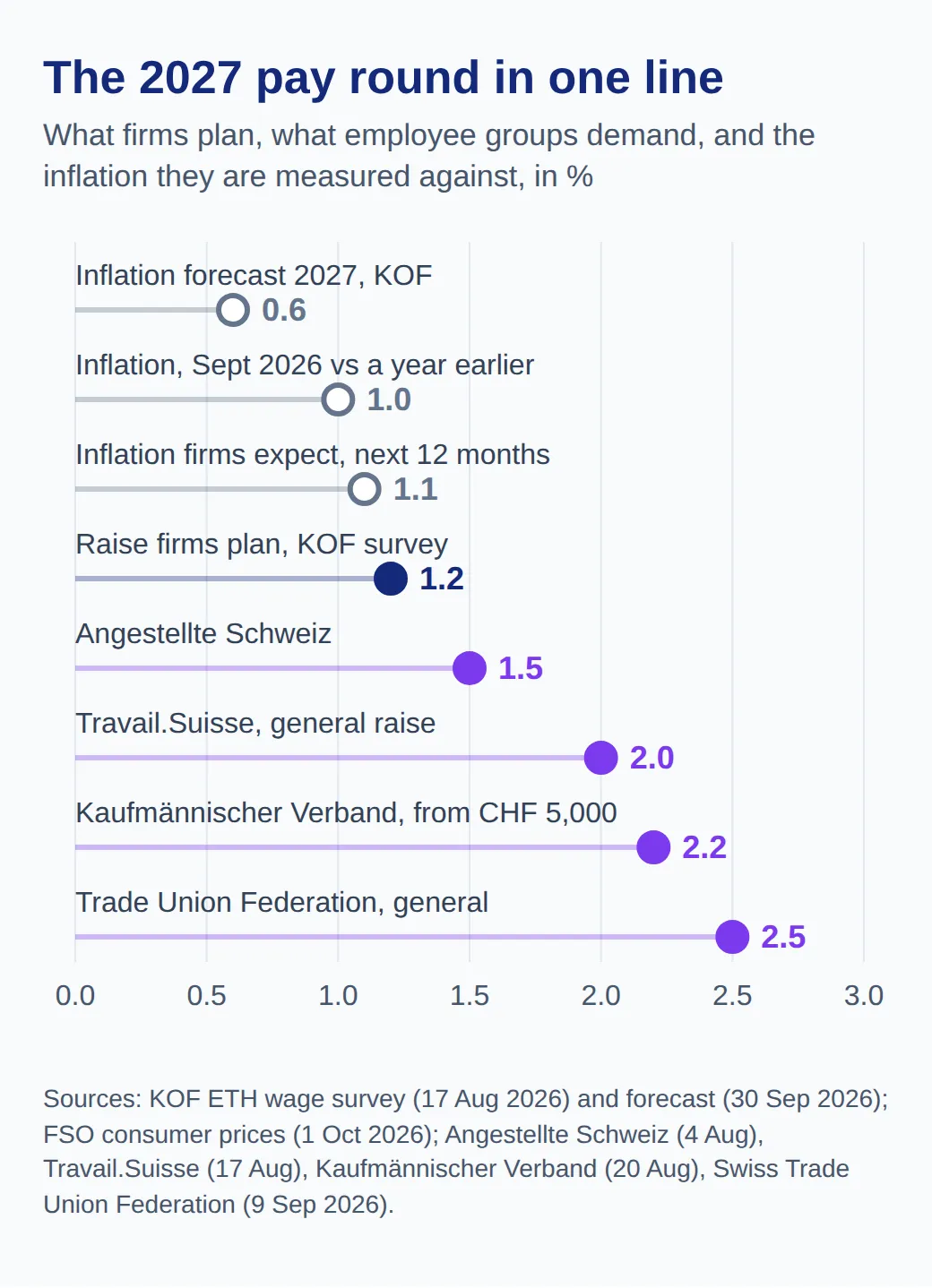
The chart shows why the word "general" matters. A plan of 1.2% sits just above the inflation firms expect themselves. The Trade Union Federation argues that individual raises are sometimes used to pay for new hires and that many employees end up with nothing, which is why it wants the whole amount paid to all. Its 2.5% is a demand, not a forecast, and none of these groups negotiates for most developers anyway. For people in IT, the more useful number comes from a survey that splits the result by sector.
The IT and telecom line in the UBS survey
UBS asks several hundred companies each year what they paid this year and what they plan for next year, and publishes the result in November. Its table has its own row for IT and telecom services. That row was at the top in the 2024 and 2025 editions (shared with energy for the 2025 plans), and its figure has come down each year.
| Year | Figure | IT and telecom | All sectors |
|---|---|---|---|
| 2024 | paid | 2.3% | 1.8% |
| 2025 | planned, then paid | 2.0%, then 2.0% | 1.4%, then 1.4% |
| 2026 | planned | 1.7% | 1.0% |
The figures come from the UBS release of 7 November 2024, with 345 firms, and the release of 5 November 2025, with 388 firms. Two things stand out. In 2025, both IT firms and the economy as a whole paid what they had planned, so that year the planned figure was a fair guide. And the IT lead over the national figure has stayed between 0.5 and 0.7 points. The edition with the 2027 plans uses the same table; the row to look for in the German version is Informatik- & Telekomdienste.
The 2024 release also asked what drives raises. Firms put their own financial situation first, then personal factors such as performance and experience, and competition on the job market only third. Keep that order in mind when you prepare: the budget follows the company's results, and your share of it follows your record.
The swissICT salary study, which covers 37,112 salaries at 214 firms, points the same way for 2026. Its median grew by only 0.2%, after 0.4% in 2025, while senior experts gained 2.8%. Our guide to developer salaries in Switzerland has those levels by region and role. A raise of 1.7% sounds good next to the national 1.0%, but the longer record tells a different story.
Why IT pay has lost ground since 2020
The federal wage index shows IT services behind the rest of the economy over five years. The index follows wages from accident insurance data and counts base salary, cost-of-living allowances and the 13th month, but not bonuses. In the FSO's results for 2025, published in April 2026, nominal pay across all employees stood at 106.1 (2020 = 100). In IT services, NOGA divisions 62 and 63, it stood at 102.5, according to the FSO's table by sector.
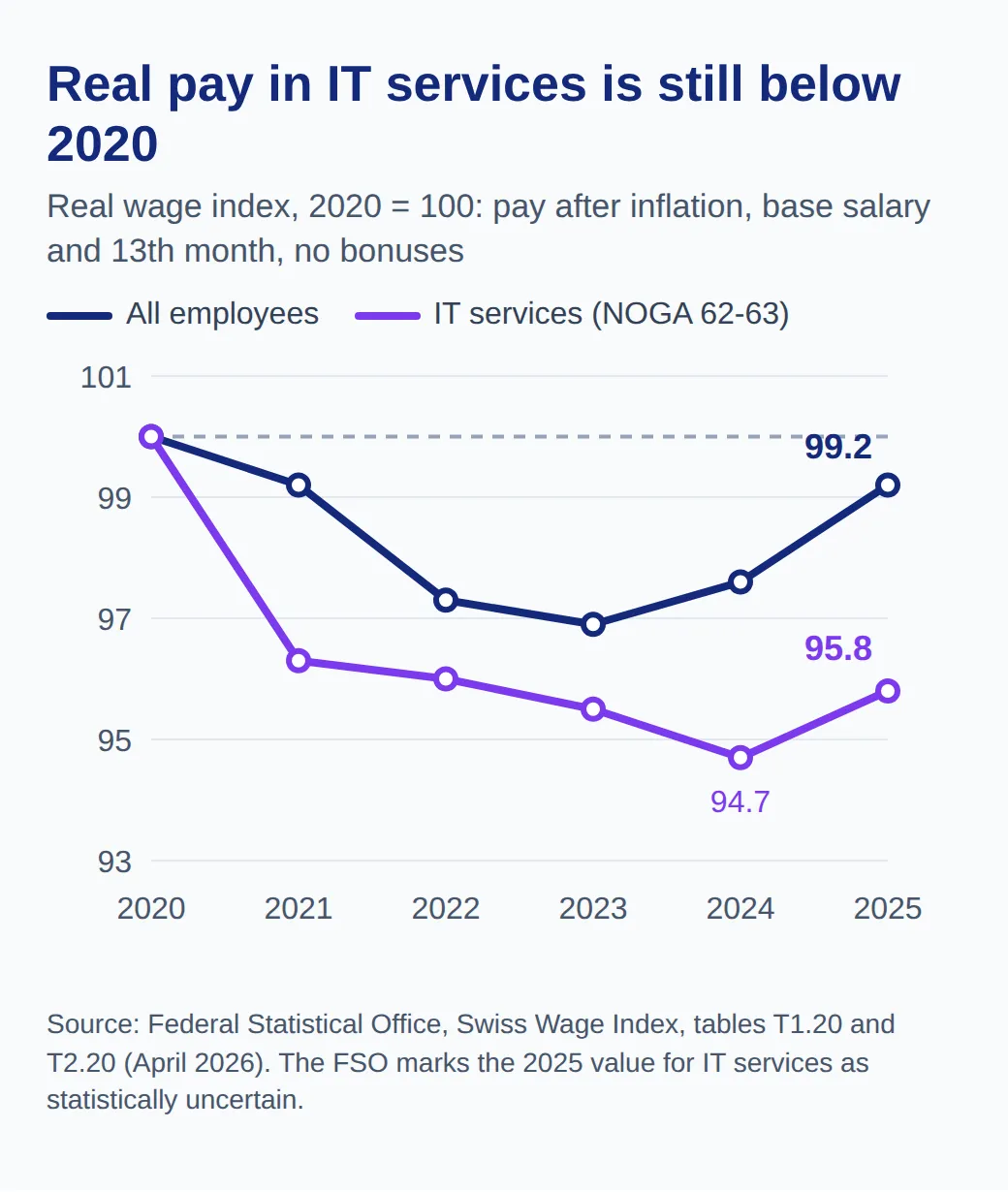
After inflation, the gap is plain. Real pay for all employees fell in 2021, 2022 and 2023, then recovered to 99.2 by 2025, close to where it started. In IT services, nominal pay fell 3.1% in 2021 alone, and real pay reached its low of 94.7 in 2024. The 2025 figure of 95.8 is one the FSO marks as statistically uncertain, but the direction is the same in the broader section of information and communication, which ended 2025 at 97.3.
This is a sector index, not your payslip. Someone who changed jobs or was promoted will have done better than the index, and plenty of developers work for banks, insurers or pharma firms, which the index counts in their own sectors. Still, it answers a question you'll hear in your pay review: has IT pay already risen a lot? Across the sector, measured this way, it hasn't kept up with prices since 2020. The next step is to understand what your employer actually owes you.
Is there a legal right to a pay rise?
No. The Code of Obligations says the employer "must pay the agreed or customary salary or the salary that is fixed by standard employment contract or collective employment contract" (art. 322). Nothing in the law adds a yearly raise or compensation for inflation. A right to one exists only where your contract, a collective agreement (in Swiss usage a GAV or CCT) or a staff regulation that is part of your contract grants it.
In practice, that means the pay round is a decision your employer makes once a year. It sets a budget, usually as a percentage of the total payroll, and then decides how to hand it out. That second step matters as much as the first.
General and individual raises: how the budget is split
A raise budget can go out in two ways. The FSO defines a general (collective) raise as the same percentage or the same amount for everyone covered, one-off bonuses paid to all included. An individual raise is a share of the payroll handed out by personal criteria such as experience or years of service, or by performance.
In the large collective agreements, those covering at least 1,500 people, the split is published. For 2025, the FSO survey of agreed raises, published in October 2025, found an average of 1.2%, of which about 70% of the budget was paid out to everyone alike and the rest as individual raises. In the information and communication section, the agreements added 1.1%.
Outside collective agreements, nobody publishes the split, and that is where most developers work. Take a budget of 1.2% split down the middle as an example: everyone gets 0.6%, and the other 0.6% of the payroll goes to some people, perhaps a third of the team getting 1.8% more on top. If you're not in that group, your raise is 0.6%, roughly what prices are expected to rise. The national average stays at 1.2% either way. The clearest published example of such a split comes from the few agreements that bind tech employers.
The few collective agreements that cover tech jobs
The best-known ones belong to Swisscom and Swiss Post, both based in Bern. The Swisscom agreement sets out the timing (clause 3.2): either side can ask for wage talks by 31 October, raises take effect on 1 April of the next year, and if they don't agree, either side can go to an arbitration court by 31 January. The criteria named are the company's results, the market and the cost of living. Base pay follows your function and your performance, and within your pay band, your raise depends on where you sit in the band and on your yearly appraisal (clause 2.7.3).
For 2026, Swisscom agreed a raise of 0.9% from 1 April for about 9,500 staff under its agreement, with about half of the money set aside for individual raises. People paid above their band got a one-off payment instead. Since 1 January 2026, a framework agreement also covers almost 600 IT specialists at seven Swisscom subsidiaries, including collective wage talks.
At Swiss Post, about 25,000 people fall under the Post CH agreement. For 2026, Post set aside about 1% of the payroll for general and structural raises, effective with the April salary, and raised the minimum salary to CHF 55,738 a year. PostFinance, which negotiates separately for about 2,700 staff, also put 1% into general and structural raises, moved its pay bands up by 0.6% (at least CHF 660), and paid a one-off CHF 500 to full-time staff.
These agreements are the exception. In 2024, 206,251 people were employed in the information and communication section, 141,974 of them in IT services, according to the FSO business census. The large agreements in that section covered 26,465 people in 2025, about one in eight. If you're among the other seven, nobody negotiates your raise for you, so the case has to come from you.
How to make your case before the letter arrives
Start with timing. If your raises apply from January, the budget is usually fixed before the letters go out, so a conversation after you've read yours is a request for next year. Ask your manager when the budget is set and whether there is an individual part, and have the conversation before that date.
Then bring three numbers, all from official sources:
- How much prices rose since your last raise. The FSO's inflation calculator gives the exact figure for any period. Enter the month of your last raise and your salary then.
- What your profile earns. The FSO's Salarium calculator estimates a monthly wage for your industry, region, occupation, age and education, from the 2024 wage survey.
- What happened in your sector. The wage index above: real pay in IT services at 95.8 in 2025, with 2020 at 100.
Here is what the calculator returns for someone whose salary of CHF 120,000 hasn't moved since January 2021: to buy the same in September 2026, they'd need CHF 130,070.
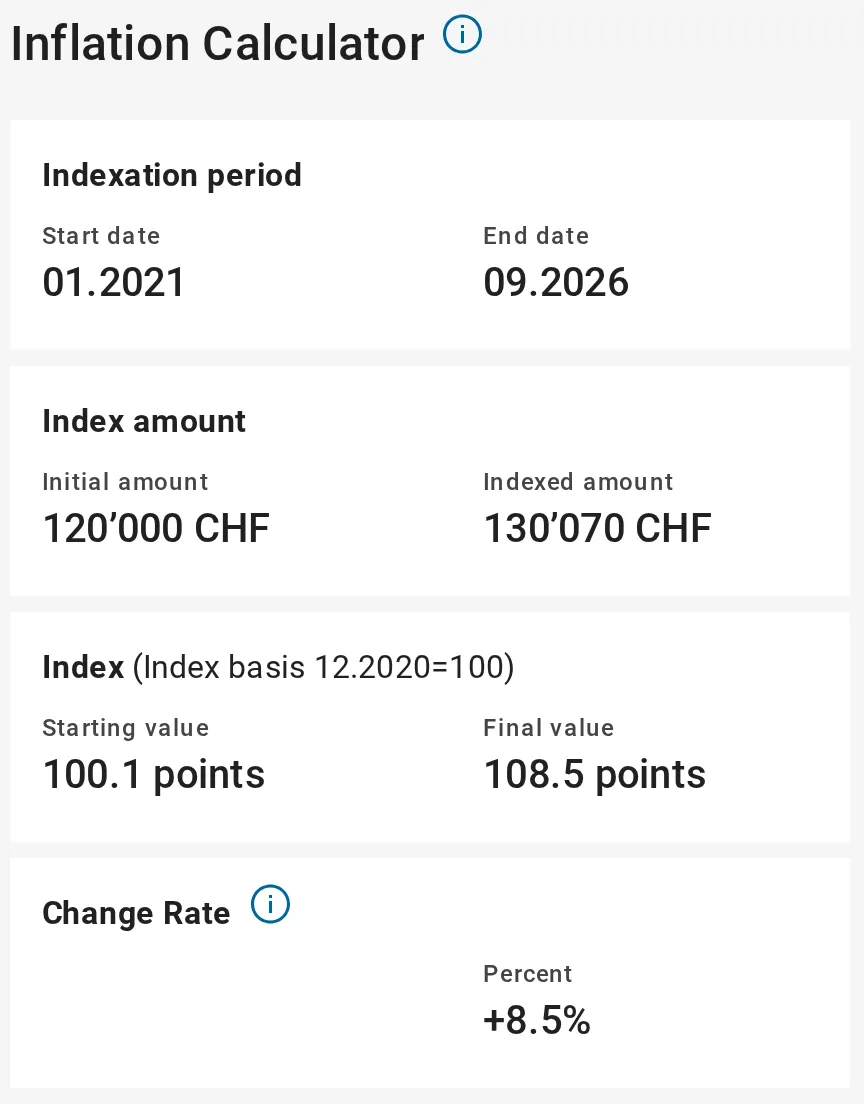
Health insurance comes on top, since the price index doesn't capture premium rises directly, as the Kaufmännischer Verband points out. The Federal Office of Public Health puts the average adult premium for 2027 at CHF 487.60 a month, CHF 22.80 more than in 2026. That's CHF 273.60 a year, so on CHF 120,000, a raise of 1% (CHF 1,200 gross) loses almost a quarter of its value to the premium increase alone.
Firms rank their own results first and your performance second, so link your ask to both. Name what you shipped, what it saved or earned, and where you sit in your band if your employer uses bands. A short written note before the meeting helps your manager argue for you in the budget round:
Before this year's pay review, I'd like to discuss my salary. Since my last raise in [month and year], prices have risen by [x]% (FSO inflation calculator), and Salarium puts my profile at CHF [y] a month. Over the year I [result]. I'd like to ask for a raise of [z]% from the individual part of the budget. Could we talk before the budget is fixed?
If the answer is no, ask what would have to change for a yes, and when the next review is. Write it down. And if the gap to the market is large, the market is the other way to close it; our guide to tech interviews in Switzerland covers how hiring works here.
Where this leaves you for 2027
If the pattern of the 2024 and 2025 UBS surveys holds, IT raises will again land above the national average, and part of the budget will go only to some people. The national figures won't tell you which part you'll get. Your appraisal, your place in the band and the conversation you have before the budget is fixed will.
If the letter falls short, compare it with what employers are advertising now. Some of the ads on our board for software engineering jobs in Zurich state a salary band, the most direct market check you can get.
Common questions
- Can my employer cut my salary for 2027 instead of raising it?
- Not on its own. Your salary is part of your contract, and a contract changes only if both sides agree. An employer that wants to pay less has to give notice and offer you a new contract at the lower pay, which can start only once your notice period has run out. Unless your contract says otherwise, that period is one to three months depending on your years of service (Code of Obligations art. 335c).
- Is a one-off bonus the same as a raise?
- No. A one-off payment, like the CHF 500 PostFinance paid its full-time staff in 2026, is paid once. It does not raise your base salary, so next year's raise is calculated on the old figure. The federal survey of collective agreements still counts such payments as part of a pay round, which is one reason averages can look better than your payslip.
- When do the next official figures come out?
- UBS publishes its salary survey each November, on 5 November in 2025 and 7 November in 2024. The Federal Statistical Office publishes the raises agreed in the large collective agreements at the end of October and the wage index for the past year in April. Its consumer price figures come out at the start of each month.
- Does a raise also increase my 13th salary?
- If your contract defines the 13th salary as one extra monthly salary, yes, because it follows the monthly figure. The official statistics treat it the same way: both the wage index and the collective agreement survey count the 13th month as part of pay. Check the wording in your contract if it names a fixed amount instead.
More posts
All posts
On-Call Duty in Switzerland: Working Time and Pay (2026)
On-call duty in Switzerland: when standby counts as working time, the 7-days-in-4-weeks cap, rest after a night of pages, and what standby pays.

Intellectual Property in Swiss Employment Contracts, 2026
Who owns the code, inventions and side projects you make as an employee in Switzerland, what IP clauses say, open source, and when a non-compete binds.

Tech Jobs in Switzerland Beyond Zurich: Five Hubs in 2026
Tech jobs in Switzerland outside Zurich: who hires developers in Bern, Geneva, Lausanne, Zug and Basel, and what rent and health insurance cost in each.