Relocation Packages in Switzerland: Tax and Clawbacks (2026)

Before you accept
If a Swiss company hires you directly and pays for your move, almost every part of the package is taxable salary: a cash allowance, the removal firm, a flat, school fees, even the tax the employer pays for you. The tax-free cases are narrow: a move your employer forces on you, or a posting by a foreign employer for at most five years.
Most pages on this subject get that wrong in one of two ways. Forum threads swap figures from one offer without saying what the tax office does with them, and tax firms write for posted executives, whose rules do not apply to someone who answered a job ad. We went to the sources instead: the 2026 guidance that every Swiss employer follows to fill in your annual salary certificate, the Expatriates Ordinance, a Zurich tax practice note, a St. Gallen tax ruling, and two relocation rules that employers have published in full. One is an addendum the building materials group Amrize filed with the US Securities and Exchange Commission for a hire in Zug. The other is the rulebook EPFL, the federal institute of technology in Lausanne, uses for new professors.
What a relocation offer usually contains
There is no official survey of relocation packages in Switzerland, so the best evidence of what employers offer is what they write down. The two published rules cover the same ground in very different ways.
| Part of the offer | Amrize addendum, Zug, 2025 | EPFL rules for new professors, 2024 |
|---|---|---|
| Moving your things | Door-to-door shipping, a 20 or 40 foot container, up to 3 months' storage | Actual costs refunded, within the overall cap |
| Travel | One-way economy travel for you and your family | Economy flights, trains, taxis |
| Housing | A relocation agent helps find temporary and permanent housing | Agent up to CHF 3,000 plus VAT, hotel for up to 6 days |
| Cash | CHF 5,000 a month gross, June 2025 to December 2026 | None, refunds only: CHF 10,000 within Switzerland, 15,000 from the EU, 25,000 from elsewhere |
| School | Not mentioned | Up to CHF 30,000 a year for three years, in exceptional cases |
| If you leave | Pro rata repayment within 24 months | Full repayment within one year |
The Amrize addendum also pays for a tax adviser for two years and promises that the relocation benefits come "net of Swiss tax and Swiss social security", unless it says otherwise. It does say otherwise for the monthly allowance: that is paid gross, with tax and social security at the employee's expense. The EPFL rules add a French course of up to CHF 10,000 in exceptional cases, and say plainly what most offers leave out: the refunds are paid into your Swiss salary account "and are subject to tax".
Neither is a typical offer for a mid-level developer, who is more likely to see a single lump sum or a smaller set of paid services. But the parts are the same ones you will negotiate over: a cash amount or services paid on your behalf, the shipping, a few weeks of temporary housing, flights, perhaps school help, and a repayment clause. What changes from one part to the next is how it is taxed.
Is a relocation package taxable in Switzerland?
Yes, for a direct hire. The guidance on filling in the salary certificate, published by the Federal Tax Administration (ESTV) and the Swiss Tax Conference and valid from 1 January 2026, puts relocation payments "flat-rate or actual" (in our translation) on the list of irregular benefits in box 3 of the certificate. That certificate, the Lohnausweis, is the form your employer gives you every year and the tax office uses to tax you. Box 3 is taxable income like your salary. The guidance's general rule is just as clear: in principle, everything an employer provides is taxable and goes on the certificate.
Two exceptions exist, and both depend on why you move. If the move is needed because of "external professional compulsion", such as an employer moving its seat, the actual costs the employer pays are only noted as a remark in box 15 and are not taxed. The same goes for actual moving costs of a posted employee under the Expatriates Ordinance. A flat-rate relocation payment goes into box 3 "in every case".
Zurich's tax office explains where the line runs in its practice note on moving costs, and it is the passage that decides most developers' cases.
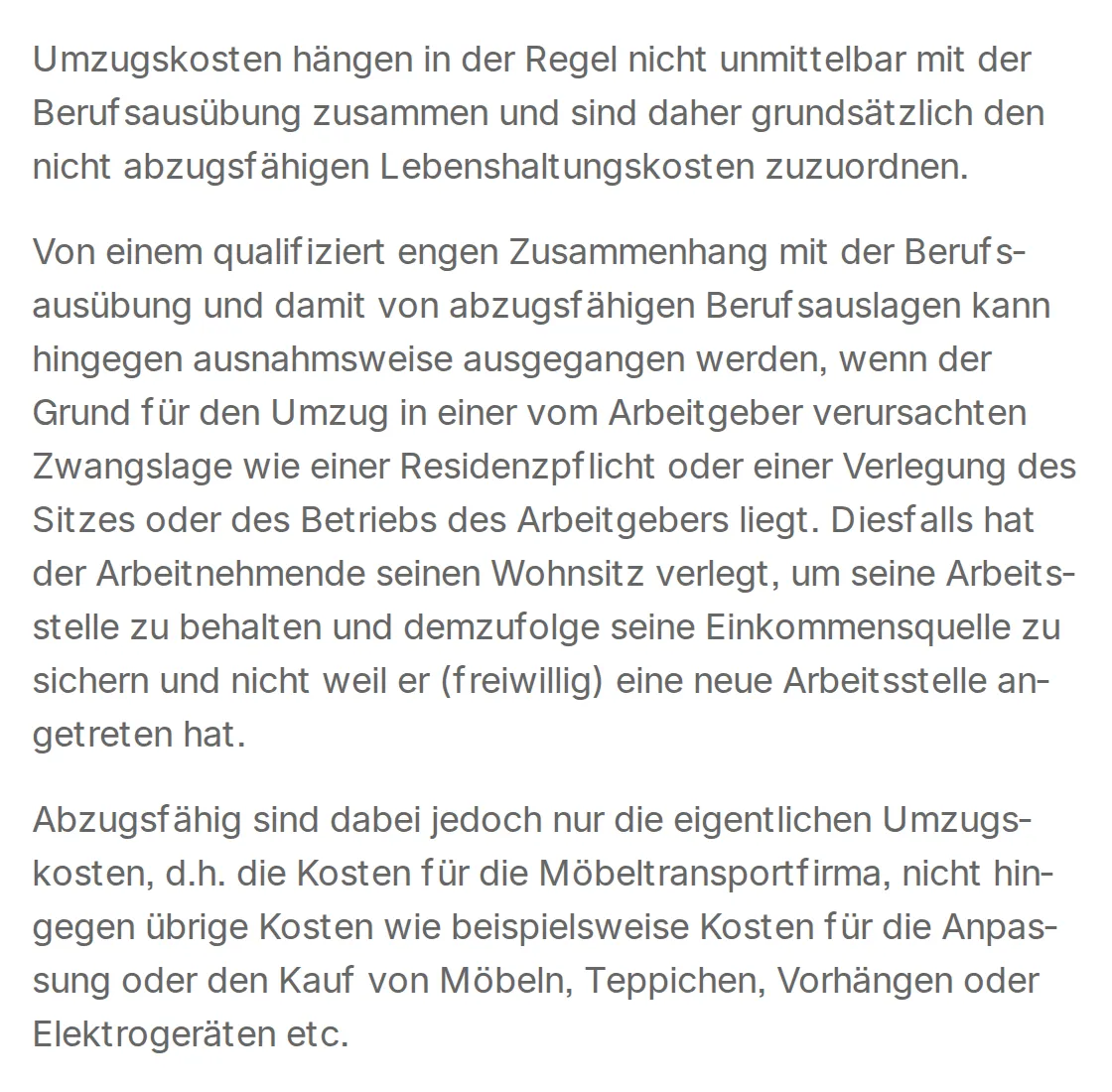
Moving costs, it says, are "as a rule" private living costs. They count as work costs only where the employer created the need to move, through a duty to live near the workplace or by moving its seat or operations. In that case the employee moved to keep the job, "and not because he (voluntarily) took up a new job". Even then, only the removal firm counts, not new furniture, carpets, curtains or appliances.
A case from St. Gallen shows what that means in money. In 2008 a project manager who had worked in Canada moved to Buchs, near the Liechtenstein border, for a job with a company in Liechtenstein. The employer paid a CHF 15,000 relocation allowance and a CHF 1,000 award. The tax office added the CHF 16,000 to his income, and St. Gallen's administrative appeals commission confirmed it in 2011: every payment from an employment is taxable income whatever it is called, even if no social security was deducted and even though he argued it had been put on his certificate by mistake. He could not deduct his own moving costs either. Under the rules of the time, he was neither a manager posted by a foreign employer nor a specialist on a fixed-term task, and he did not even work in Switzerland.
Where each part lands on your salary certificate
Knowing that the package is taxable is half the answer. The other half is which box it goes in, because that is what you will see on the form early each year and what you check your tax bill against.
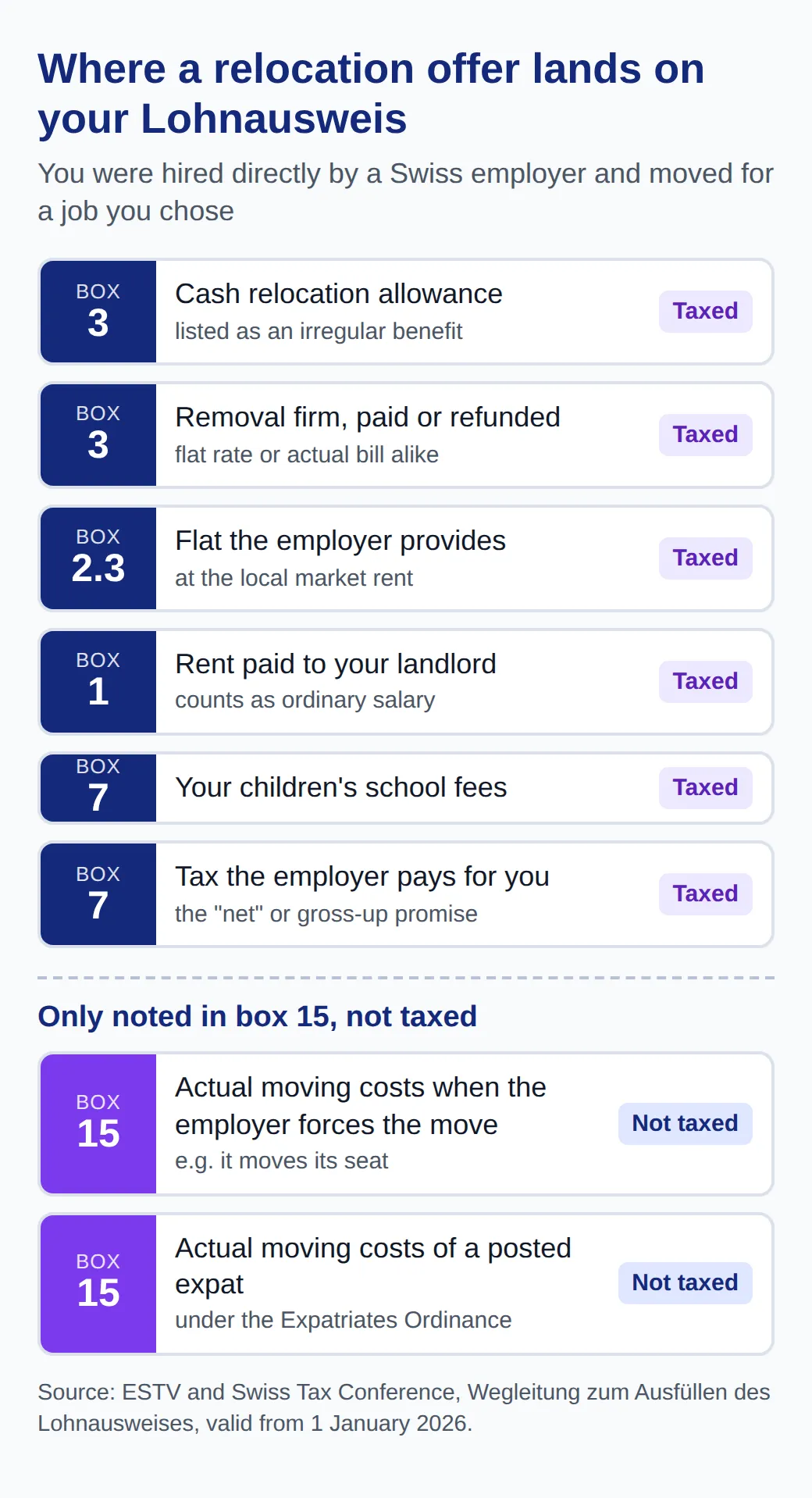
Housing has two routes. If the employer rents a flat in its own name and lets you live there, the guidance treats it as a fringe benefit in box 2.3, valued at the local market rent. If the employer simply pays your landlord, that payment is part of your ordinary salary in box 1. A serviced apartment for your first month is a benefit either way.
School fees the employer pays for your children have their own line in box 7. So do taxes the employer takes on for you. That matters for any offer written "net", like the Amrize addendum. If the company pays the tax on your relocation benefits, that tax payment is itself income, which is why a promise to cover the tax is more expensive for the employer than it looks and why the figure on your certificate can be well above the cost of the move.
A flight home once a year is not on the list of exceptions, so it follows the general rule and is taxable. The exceptions in the guidance are small and specific: a free half-fare travelcard, gifts in kind up to CHF 600 a year, a free parking space at work and a few others. None of them covers a part of a relocation.
Social security asks a different question
Contributions to AHV, the old-age and disability insurance, follow their own guidance, and it draws the line elsewhere. The federal social insurance office's guidance on what counts as salary treats payments for moving to a new home for work reasons as expenses, which carry no contributions. The extras around a move do not get that treatment: payments for the flat hunt, broken contracts, or having to sell a car or furniture count as salary, and so do rent subsidies and private school fees. So the same allowance can be free of AHV and still be taxed. The St. Gallen project manager made that argument and lost: no contributions had been taken on his allowance, and the commission said that changed nothing for tax.
Why the expat deductions probably don't apply to you
The deductions most tax pages describe come from the Expatriates Ordinance (ExpaV), and they are generous. An expatriate who lives in Switzerland can deduct the cost of the move here and back, travel for the family at the start and end, reasonable housing costs while keeping a home abroad, and fees at a foreign-language private school where the public schools do not teach in the child's language. If you keep a home abroad, a flat CHF 1,500 a month can be deducted instead of the actual moving, travel and housing costs. When the employer pays these costs directly or refunds them against receipts, they are not taxed at all.
The catch is who counts as an expatriate. Since 1 January 2016 the ordinance covers only managers and specialists whom their foreign employer posts to Switzerland for a limited time, at most five years. The deductions end as soon as a permanent job replaces the temporary one. The canton of Bern's factsheet on expatriates' expenses names IT and telecoms specialists as the typical specialist case, but it also spells out what a posting means: your contract with the foreign employer continues, or you get a local contract with the Swiss group company together with an agreement that the foreign company takes you back.
That rules out most developers reading this. If you applied to a Swiss company, signed a Swiss contract and have no job to return to abroad, you are a direct hire, however international the team. A fixed-term contract does not change that. The original version of the ordinance from 2000 also covered "specialists of all kinds" with a fixed-term task in Switzerland, without a posting, and some guides still describe that older rule. People who qualified under it before 2016 kept their status until their fixed term ended, but nobody can join that group now.
Two more limits apply even to real expats. A flat-rate payment from the employer is added to taxable salary, with the deduction claimed separately. And the ordinance excludes furnishing a home, higher Swiss prices and taxes, and legal and tax advice.
Clawback clauses: what you repay if you leave
A relocation package almost always comes with a condition: stay long enough or pay some of it back. The two published rules show the two common shapes.
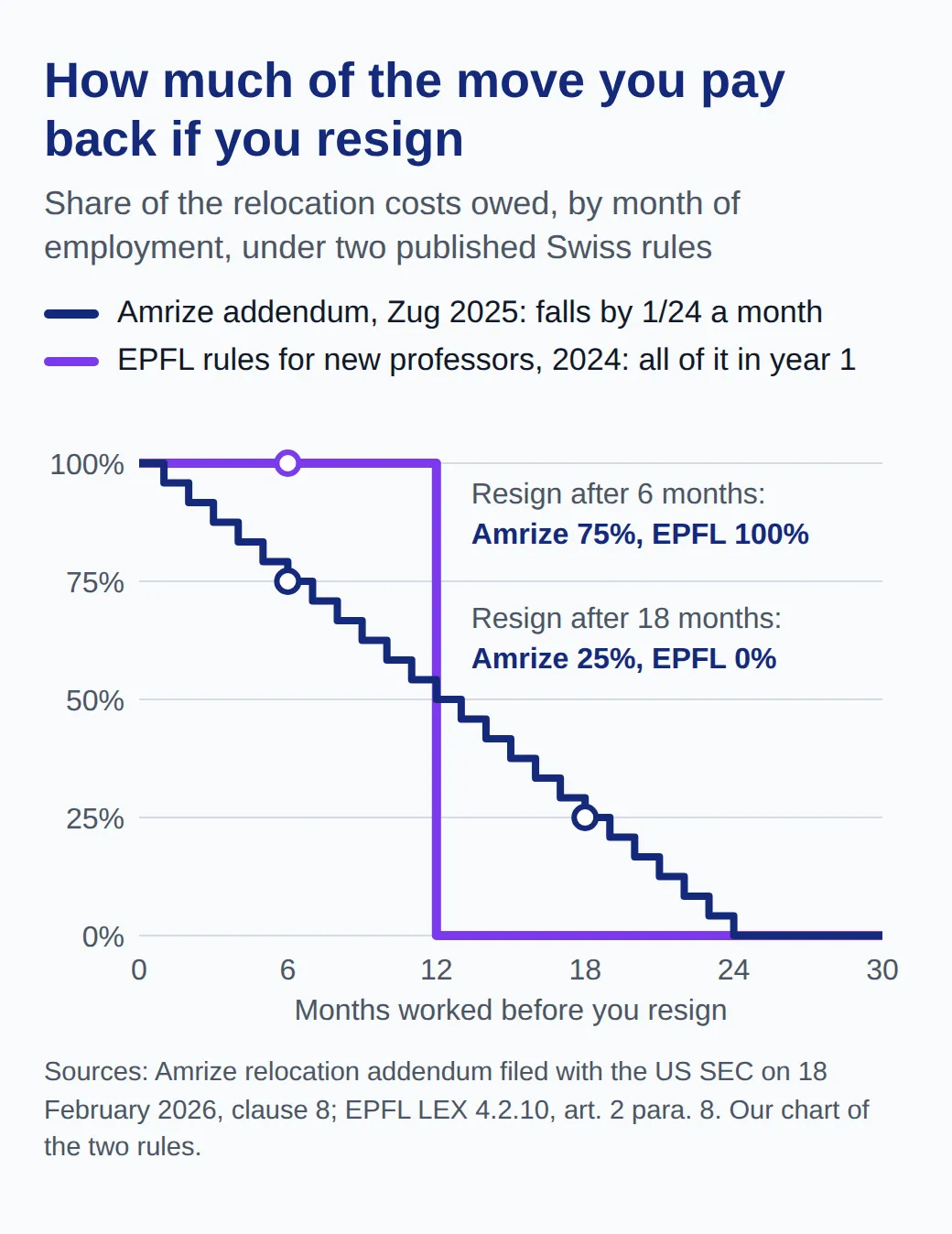
EPFL's rule is a cliff. A professor who leaves less than a year after starting repays the relocation costs, and from the first anniversary owes nothing. Amrize's is a slope. If you give notice within 24 months, you repay the costs pro rata, reduced by 1/24 for every month worked. Resign after six months and you owe 75%; after 18 months, 25%.
Three details in the Amrize clause are worth looking for in your own. The amount to repay covers every benefit in clauses 1 to 5 of the addendum, the monthly CHF 5,000 allowance included, plus the Swiss withholding tax and employee social security contributions the company paid on them, so a "net" package can cost you more to unwind than the move itself cost. The trigger is your resignation, or a dismissal for a gross breach of the contract or other important reasons; the end of the job through restructuring, retirement, disability or death does not trigger it. And the company may set the debt off against your last salary, with any rest due within ten calendar days of the end of the job.
That last point meets a limit in the law. Under the Code of Obligations, an employer may set its claims off against your salary only to the extent the salary could be seized, unless the claim is for damage you caused on purpose. Part of your final pay is protected whatever the clause says.
The law has no article written for relocation clawbacks, and we found no ruling of the Federal Supreme Court on one. The closest guidance comes from clauses that make staff repay training costs. Summing up the leading commentaries, the Aargau staff appeals court held in 2005 that such a clause is valid when it pays back a special benefit, runs for at most three years and shrinks the longer you stay. It cannot reach a benefit that serves only the employer and leaves you no lasting gain. And it falls away when the employer dismisses you without a reason you gave it, or when you resign for a reason the employer is responsible for.
Behind that sits article 327a of the Code of Obligations, which obliges the employer to refund all expenses the work necessarily causes and makes void any agreement that you bear them yourself. Applied to a move, our reading is this, and it is no more than a reading. When you move to take up a job you chose, tax law already treats the move as your own cost, as Zurich's practice note shows, so the package is a special benefit on top, and a clawback that shrinks month by month, like Amrize's, fits those limits. When an employer sends you to another office, the move is much closer to a work expense, and a clause making you repay it is open to challenge. Where your case sits between the two, a lawyer or your cantonal labour office can tell you more than any clause will.
What to ask for before you sign
Since a direct hire pays tax on nearly everything, the form of the package matters less for tax than for your cash flow and your freedom to leave. Cash gives you choice; paid services save you from fronting a container bill. Either way, it all ends up on your certificate.
Ask four things. Is the amount gross or net, and if net, does the repayment include the tax the employer paid? When does the clawback end, and does it shrink month by month or drop off at once? Is a dismissal you did not cause excluded? And is the whole thing in writing, as an addendum to the contract you sign? A short email does it:
Before I sign, could you confirm in the relocation addendum that any repayment covers only the relocation costs themselves, not tax paid on my behalf, that it falls pro rata for each month worked and ends after 12 months, and that it does not apply if the company ends my employment for reasons other than my own serious breach?
Then check the outcome early in the following year. Your first salary certificate should show the relocation payments in box 3, any flat in box 2.3 and school fees in box 7. An employer may fold box 3 items into your salary in box 1 when you worked the whole calendar year, so look there too before you assume something is missing. If you are a direct hire and something appears only as a remark in box 15, ask HR why, because that treatment is meant for forced moves and posted expats.
If your offer also depends on a work permit, our guide to Swiss permits for non-EU developers covers that side, and our look at developer salaries helps you judge whether the package is making up for a low base. For the clause that follows you out of the door, read when a non-compete actually binds.
Common questions
- Can I deduct my moving costs myself if the employer pays nothing?
- Usually not. Swiss tax offices treat a move to start a job you chose as a private living cost, which the federal tax law does not let you deduct. The exceptions are the same as for an employer's payment: a move the employer forces on you, such as a transfer after it moves its seat, or a posting from a foreign group company under the Expatriates Ordinance.
- Does the same rule apply if I move from Bern to Zurich for a new job?
- Yes. The rule is about why you move, not how far. A move within Switzerland to take up a new job is voluntary in the eyes of the tax office, so a relocation allowance is taxable salary and your own costs are not deductible. Only a move the employer forces, for example because it relocates the office you already work in, is treated differently.
- Do I pay social security contributions on a relocation allowance?
- It depends on what the money pays for. The federal guidance on what counts as salary for AHV treats a payment for moving to a new home for work reasons as an expense, which carries no contributions. Payments for the flat hunt, broken contracts, selling furniture or a car, rent subsidies and private school fees count as salary. The tax office decides separately, so a payment can be free of AHV and still be taxed.
- Do I have to repay the package if the company lets me go?
- Only if your contract says so, and the wording matters. The Amrize addendum filed in 2026 makes you repay if you resign or are dismissed for a gross breach or other important reasons, but not if the company ends the job for restructuring. EPFL's rule speaks of a professor who leaves within a year and does not say why. A Swiss ruling on training-cost clauses, following the leading commentaries, says repayment falls away when the employer dismisses you without a reason you gave it, but ask for that case to be excluded in writing anyway.
- Is a signing bonus treated differently from a relocation allowance?
- Not for tax. The Lohnausweis guidance lists joining payments and relocation payments side by side as irregular benefits in box 3, and both are taxable salary. The difference is in the contract: a relocation payment is often tied to the move and comes with a repayment clause, while a signing bonus may have its own conditions.
More posts
All posts
Non-Compete Clause in Switzerland: When It Binds Developers
When a Swiss non-compete clause really stops a software engineer joining a rival: the four tests, the three-year cap, penalty cuts and when it lapses.

Software Engineer Salary in Switzerland 2026, by Region
Software engineer salary in Switzerland: federal pay data by region and age, swissICT's 2026 levels, real salary bands from job ads, and what drives the gap.

Swiss Work Permit for Non-EU Software Developers in 2026
How a non-EU developer gets a Swiss B or L permit in 2026: who applies, quotas per canton, why developers count as a shortage job, pay checks and timelines.