Non-Compete Clause in Switzerland: When It Binds Developers

Before you resign
A Swiss non-compete clause stops you joining a competitor only if you signed it in writing, your job showed you the employer's clients or real trade secrets, and using that knowledge could do serious harm. It must be limited in place, time and subject, normally to three years at most. Judges cut back clauses that go too far, and the ban lapses if your employer lets you go without a reason you gave.
That sums up articles 340 to 340c of the Code of Obligations, and each condition can fail on its own. Most of what you find on this question is written by law firms and HR companies for employers who want to draft a clause that holds. We did the reverse. We wrote a clause of the kind tech contracts carry, then tested it, line by line, against the law and eleven Federal Supreme Court rulings, the oldest from 1983 and the latest two from 2025.
The clause we tested
Here is our example. We wrote it ourselves, but most of it echoes clauses that ended up in court: a long ban, sweeping wording, a penalty of a year's pay, and a line saying that paying the penalty does not free you.
For 24 months after the end of the employment relationship, the Employee shall not work for, advise or hold an interest in any company active in software or technology services, worldwide. For each breach, the Employee shall pay a contractual penalty equal to twelve months' gross salary. Payment of the penalty does not release the Employee from the prohibition.
Picture the person who signed it: a backend engineer at a Zurich software firm that builds banking apps, four years in, now holding an offer from a rival. Does the clause stop the move? It has to pass four tests first, and the first one is about paper.
Test 1: Did you sign it in writing?
A non-compete needs the written form, with your signature (art. 340 para. 1 CO). One agreed only by word of mouth is void, as the Federal Supreme Court repeated in BGE 145 III 365. The University of Zurich's career service adds that a mere reference to the staff regulations is not enough: the ban belongs in the contract or a separate signed agreement. The same ruling recalls an older case where a clause that only pointed to the legal provisions, without saying what was banned, was held invalid.
Don't count on loose wording to save you, though. In BGE 145 III 365 a marketing assistant argued that a ban on "any competing activity" across Switzerland for three years was too vague to be valid. The court disagreed: that phrase is the law's own wording, and it is precise enough. Our example clause would pass this first test if it sits in the contract you signed. The second test is where most developer cases turn.
Test 2: Does a non-compete apply to a software developer?
Only if your job let you see the employer's clients or its manufacturing and business secrets, and only if using that knowledge "might cause the employer substantial harm" (art. 340 para. 2 CO). Both halves have to be true. What counts is what your job actually let you see, not your title.
General know-how is not a trade secret
The Federal Supreme Court has drawn the line in the same words for years. A business secret is something particular to your employer, such as its price calculations, margins, organisation or staff matters, that is not generally known, not easy to find out, and that the employer wants kept secret. Knowledge you could pick up at any firm in the sector is not a secret. It is your general professional experience.
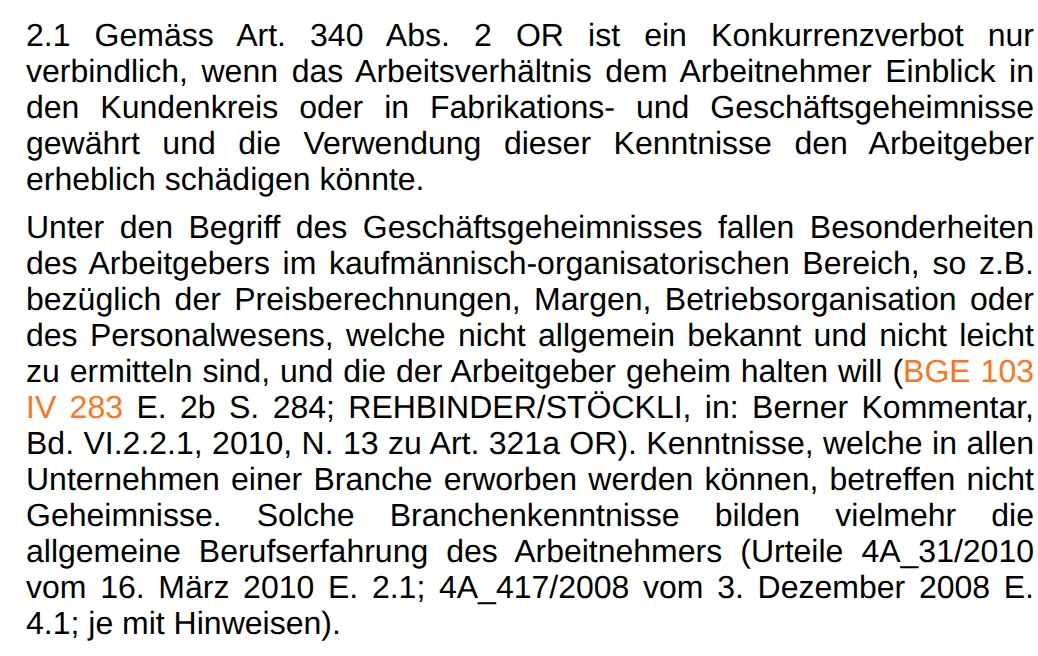
That passage comes from 4A_283/2010, where a taxi firm tried to stop its former manager from running his own taxi company. He had seen the books and the drivers' pay, and the courts still found no secrets worth protecting. BGE 138 III 67 says the same for technical matters: they must be specific to the employer, not knowledge any firm in the branch would give you.
No Swiss ruling we found deals with a software engineer, so the table below is our reading of those principles for typical developer knowledge.
| What you know | How the rulings treat it |
|---|---|
| Languages, frameworks, cloud platforms, design patterns | Sector knowledge: your experience |
| How payment, search or ML systems work in general | Sector knowledge: your experience |
| The employer's unreleased pricing logic or margins | Can be a business secret |
| Who decides at a client, and their contract terms | Insight into clients |
The last row matters most for consultants. If you work for an IT services firm and sit with the client's team every week, you probably have insight into clients. In 4A_70/2025, a staffing consultant argued that the list of firms in his field was public. The court said client information need not be secret: knowing whom to call, and being able to offer them the same service, is enough.
When clients follow you, not the firm
There is one exit from the client test. If clients come back because of your own skills, not because of the company behind you, the harm comes from your talent, and the clause does not bind. In BGE 138 III 67, two trainers at a training firm were free to compete because a witness put the weight of their personal qualities in clients' decisions at 70%. That exception needs a strong personal element, so it suits a well-known freelance-style consultant better than an engineer in a product team.
For our backend engineer with no client contact and no access to pricing, the clause probably fails here. A lead consultant who ran the bank's account is a different case. If the clause survives this test, the next question is how far it reaches.
Test 3: Is it limited in place, time and subject?
The ban must be "appropriately restricted with regard to place, time and scope" so it does not unfairly hold back your career, and it "may exceed three years only in special circumstances" (art. 340a CO). Courts weigh the three together. In 4C.44/2002, the court said a very short ban may cover a much wider area, and a worldwide ban is easier to justify when the banned activity is narrowly described, so you can easily move to other work.
"Worldwide" and "any tech company"
Our clause fails on both counts. On place, the court in 4C.44/2002 held that a ban may not reach beyond the area where the employer actually does business, because outside it the employer cannot be harmed. In 4A_5/2025, a country manager's clause named no area at all. Because his employer was the Swiss arm of an international group that only sold in Switzerland, the courts read the ban as covering Switzerland. If you work for the Swiss subsidiary of a global tech company, that reasoning is worth knowing.
On subject, the law only lets an employer ban competing activity. The same 2002 ruling defined competition: two firms offer the same kind of service to at least partly the same customers in the same area. A payroll start-up and a game studio are both "technology companies", but they do not compete. A clause that bans every software employer reaches far beyond what the employer can protect, and that is exactly what a judge may trim.
What a judge does with a clause that goes too far
A clause that goes too far is not thrown out. The court may "at its discretion" narrow it, and must take into account anything the employer pays for it (art. 340a para. 2 CO). The case that shows this best is 4A_62/2011. A field sales rep selling tools and chemicals to the stone industry signed a three-year ban on "any competing activity", with no area named and a penalty of the previous year's salary, capped at CHF 100,000.
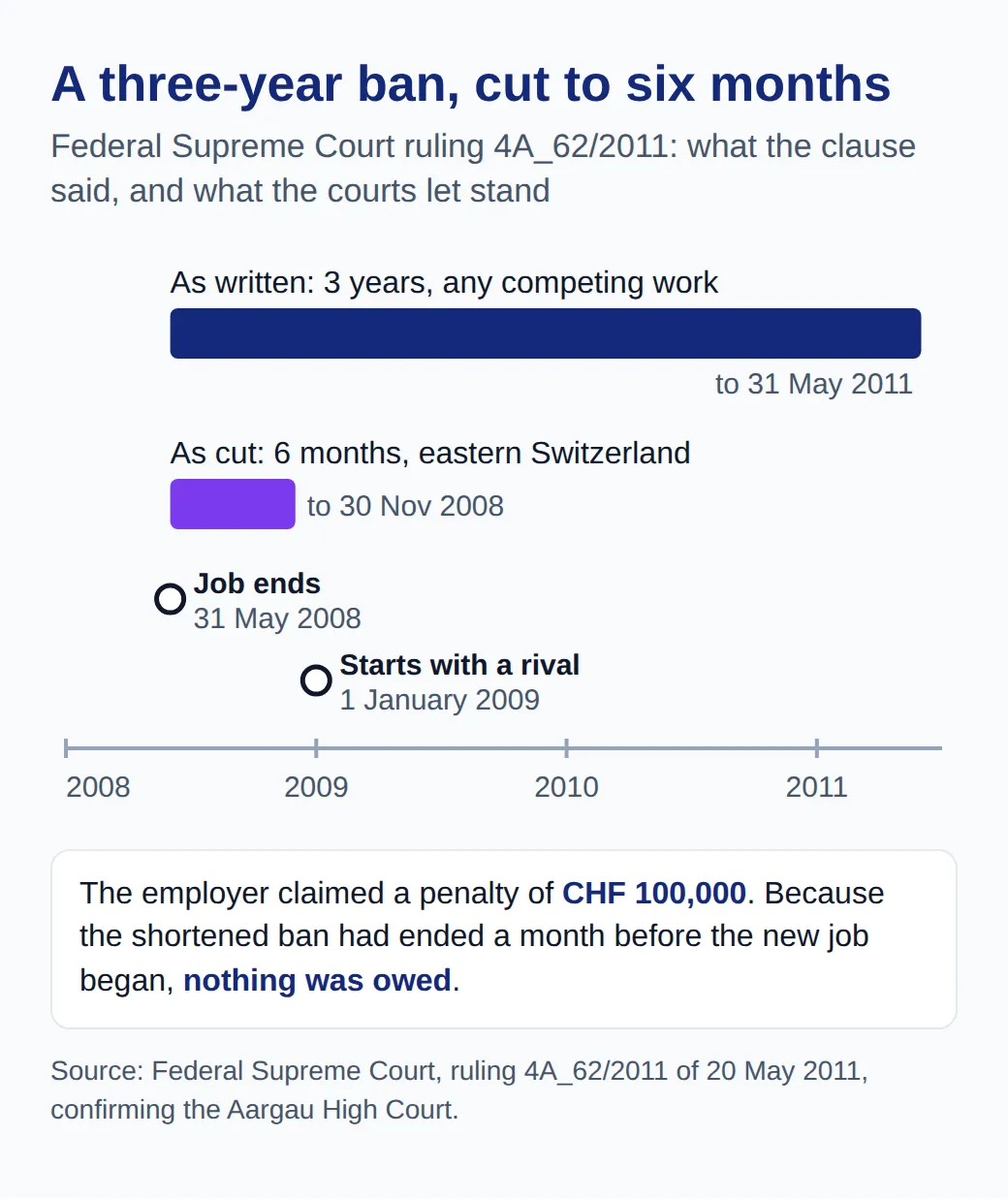
The Aargau High Court limited the ban to the region he had covered and to six months. The Federal Supreme Court upheld the six months, which made a ruling on the region unnecessary. Knowledge of clients, it said, loses its value once a successor has been introduced to them, and legal writers put the protection for client insight at about six months, within a range of a few to 18 months. Real trade secrets justify longer bans. The employer had also left the territory without a successor for six or seven months. The rep started with a competitor on 1 January 2009, a month after the shortened ban ended, so the CHF 100,000 claim failed entirely.
Applied to our example, a judge would likely narrow "worldwide" to the employer's real market, "any technology company" to direct rivals, and 24 months to what the knowledge you actually had can justify. That trimming happens only in court, after a dispute, so the fourth test is often the faster way out.
Test 4: Has the clause already lapsed?
It may have. Three situations end it under art. 340c CO. The ban ends once the employer "demonstrably no longer has a substantial interest" in it, for example after it drops the business line you worked on. It also ends if the employer terminates your contract without you having given it good cause, or if you resign for good cause the employer is responsible for. The law does not let a contract take these exits away from you (art. 362 CO).
Laid off: the clause usually falls away
For developers, the second exit is the big one. If you are let go in a restructuring, because a project was cut or a team moved abroad, you gave no reason, and the ban lapses. In BGE 130 III 353, the court explained that "good cause" here is far less than the serious reason needed for instant dismissal. It means any event you are responsible for that, on a reasonable business view, gives the employer a real reason to end the contract.
That cuts both ways. In the same case, a recruiter had resigned to join a rival and was then dismissed on the spot for preparing the move at work. The dismissal itself was probably not justified, but preparing to join a competitor was reason enough, and the ban stayed. So don't line up your next employer's work from your current laptop.
When you resign
Resigning for a better offer does not end the ban. Resigning because of something the employer did can. The court in BGE 130 III 353 gave examples: pay well below the market rate, chronic overwork despite a warning, constant reproaches, or a generally poor working climate. It does not have to be a breach of contract. But if the blame is shared equally, the ban stays, as the staffing consultant in 4A_70/2025 learned. He had complained about his pay and about a new colleague hired for his sector, and the courts found both sides equally responsible.
The termination agreement trap
Many tech layoffs come with a termination agreement instead of a notice letter. Read it before you sign. In 4A_209/2008, a managing director said his firm wanted to part with him, and it offered an agreement that doubled his notice period and paid up to CHF 50,000 for outplacement. Because those terms put him clearly better off than a plain dismissal, the court treated the exit as mutual, and the lapse rule did not apply. He was ordered to pay CHF 22,000. An agreement the employer pushed for that only follows the normal notice rules, on the other hand, counts as a dismissal by the employer, whatever it is called.
If you are offered a package, ask for a line that releases you from the non-compete, and get it in writing:
I accept the termination agreement on condition that the employer waives the post-employment non-compete in section [number] of my employment contract with effect from the end of employment. Please confirm this waiver in writing.
If the clause survived all four tests and you still take the job, the question becomes what it costs.
What a breach costs, and how courts cut penalties
If you break a valid non-compete, you owe damages. If the contract sets a penalty, paying it normally frees you from the ban, unless the contract says otherwise, as our example does (art. 340b CO). The employer can force you to actually stop working for the rival only if that was "expressly so agreed in writing", and only where its interests and your conduct justify it.
Penalties can be any amount, but the court "may reduce penalties that it considers excessive" (art. 163 para. 3 CO). Judges are reluctant to step in. They do so when the penalty is grossly out of proportion to the employer's interest, looking at the length of the job, how serious the breach was, and your financial situation. You don't need a separate request: in BGE 109 II 120 the court held that asking for the whole claim to be dismissed already includes asking for a reduction, and named a seven-month job, no proven damage and an employer that no longer needed the ban as reasons that can count.
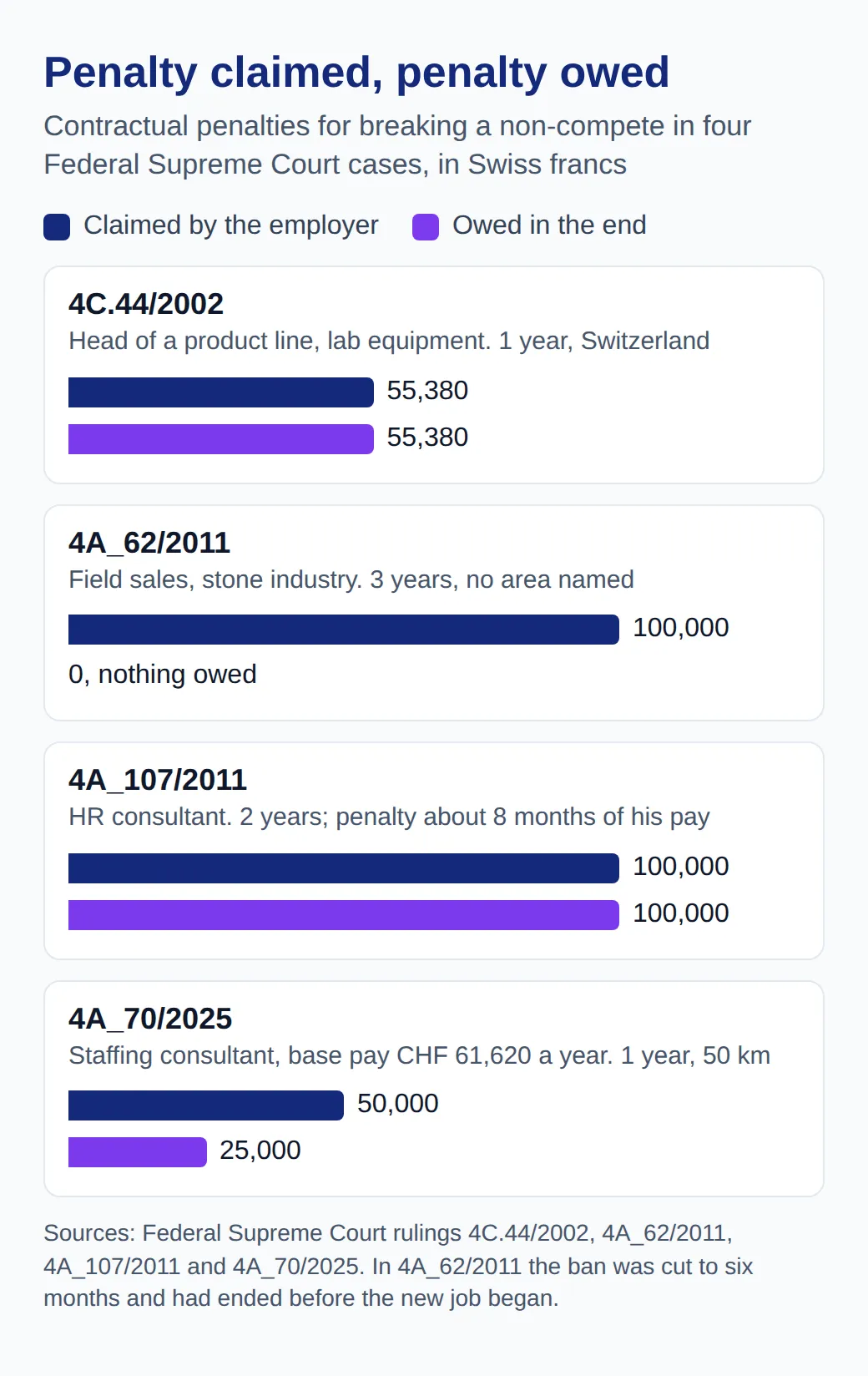
The four cases show the range. The lab equipment manager in 4C.44/2002 owed the full CHF 55,380 his employer claimed under a penalty of half a year's salary. In 4A_107/2011, an HR consultant went straight after the clients he had looked after for five years, right after his exit agreement had confirmed the ban. The courts pointed to that deliberate move and let the full CHF 100,000 stand, about eight months of his income by the court's count. The staffing consultant in 4A_70/2025, on a base salary of CHF 61,620 a year, saw a CHF 50,000 penalty halved by the Vaud court, and the Federal Supreme Court let that stand.
If the clause comes with pay
Swiss law does not require any payment for a non-compete. Some contracts offer one anyway, and then it binds the employer too. In 4A_5/2025 a country manager's contract promised him 50% of his last salary, bonus excluded, for each month of the two-year ban. When he resigned, the employer tried to cancel the clause to save the money. The court said it could not, unless the contract allowed it, and that the payment was owed whatever he earned elsewhere. Unemployment benefits are not deducted from it either.
Before you resign: check your clause in this order
Find the signed contract and any separate agreement, not the version in the HR portal. Then go through the tests in order, because the first one that fails ends the matter. Is the clause in a document you signed? Did your job give you insight into clients or real secrets, beyond what any developer in your field knows? Is it limited to your employer's real market, to direct rivals and to a period your knowledge can justify? And did the contract end in a way that makes it lapse?
If the answer still points to a binding clause, you have three options. Ask for a written waiver, which costs the employer nothing if it has no real interest. Time your start date to fall after a ban that a court would shorten, keeping in mind that only a court decides that. Or pick a new employer that does not compete with the old one in the narrow sense the courts use. If you plan to start out on your own, the same clause covers running a rival business, so read it before you register; our guide to freelancing as a developer covers the rest of that step.
Your duty to keep the old employer's secrets stays in place whether or not the non-compete binds you, and your old employer keeps the code you wrote there. Our post on who owns your side projects explains where that line runs. And when the next offer comes, read its non-compete as closely as its salary: the interview and offer stage is when an employer is most open to narrowing it. For a clause that names large sums or a dispute already under way, talk to an employment lawyer before you sign anything.
Developer jobs in Zurich and Vaud
Many of these employers don't compete with each other at all, in the sense the courts use. A bank's internal platform team and a game studio may both hire Kotlin developers, but they don't sell to the same customers.
Common questions
- Does garden leave count towards the non-compete period?
- No. A post-employment non-compete starts when the employment ends, and garden leave is still employment. In ruling 4A_5/2025 a country manager was put on garden leave in July 2021, and his two-year ban ran from 1 January 2022, the day after his contract ended. So three months of garden leave followed by a 12-month ban keeps you away from rivals for 15 months in total.
- Can my old employer get a court order to stop me starting the new job?
- Only if the contract expressly says so in writing, and only if its interests and your conduct justify it (art. 340b CO). Without that wording, the employer can claim damages or the agreed penalty, but cannot force you to stop. In 4A_283/2010 a request for an injunction failed because the employer could not show that its former manager knew any real business secrets.
- Can my employer drop the non-compete after I resign?
- An unpaid clause, yes: the employer can waive it, and the University of Zurich's career service lists a waiver as one way the ban ends. A clause that comes with compensation is different. In 2025 the Federal Supreme Court held that the employer cannot cancel it on its own to stop paying, unless the contract allows that, and that other income or unemployment benefits are not deducted unless agreed.
- Does a non-compete still apply if I am let go during probation?
- The law makes no exception for probation. If the employer ends the contract and you gave it no good reason to, the ban lapses under art. 340c CO, whether that happens in the first month or the fifth year. Keep the termination letter and any written reasons.
- Is a ban on poaching clients treated differently from a non-compete?
- Not really. The Federal Supreme Court said in BGE 130 III 353 that a ban on taking away clients is not always milder than a non-compete, and that the same conditions apply to it: written form, real insight into clients and a limited scope. A narrow non-solicitation clause is still easier to live with, because it lets you keep working in your field.
More posts
All posts
Swiss Work Permit for Non-EU Software Developers in 2026
How a non-EU developer gets a Swiss B or L permit in 2026: who applies, quotas per canton, why developers count as a shortage job, pay checks and timelines.

Relocation Packages in Switzerland: Tax and Clawbacks (2026)
What a Swiss relocation package for tech hires covers, which parts are taxed as salary, why expat deductions rarely apply, and when you must pay it back.

Tech Jobs in Switzerland Beyond Zurich: Five Hubs in 2026
Tech jobs in Switzerland outside Zurich: who hires developers in Bern, Geneva, Lausanne, Zug and Basel, and what rent and health insurance cost in each.